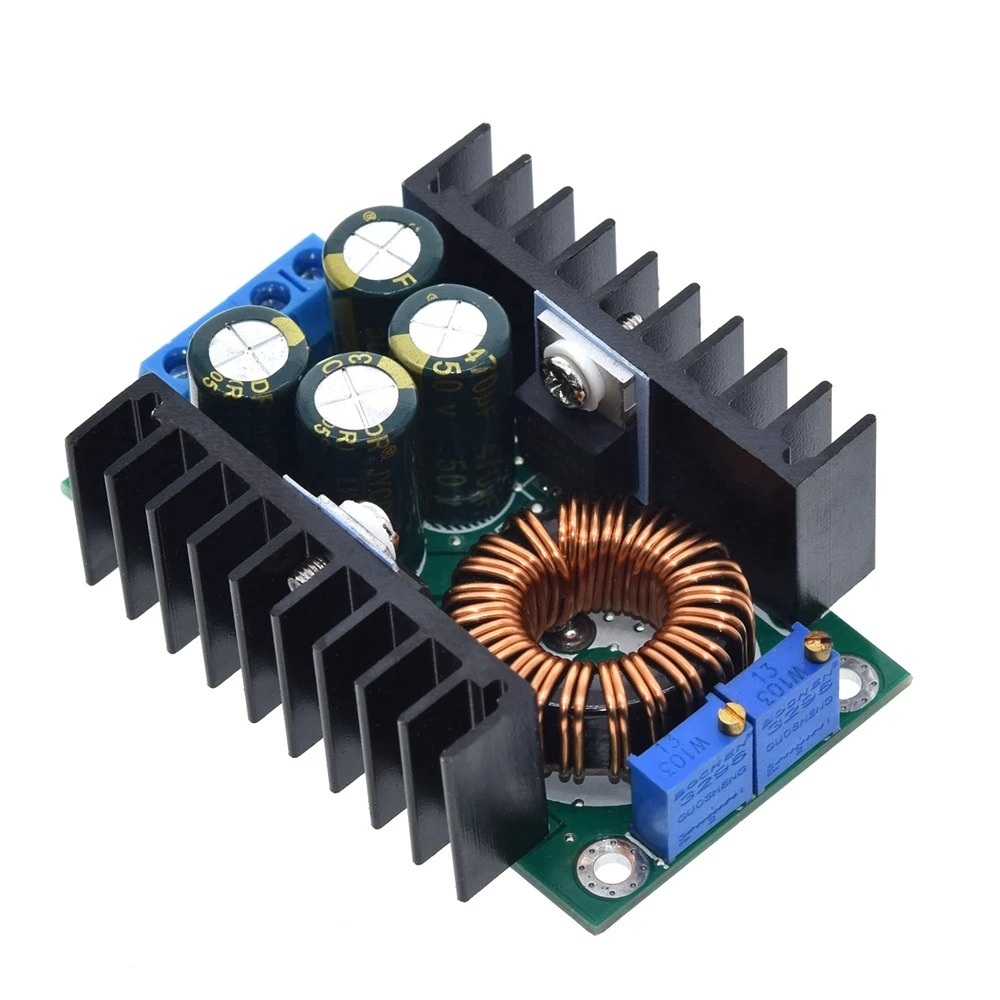
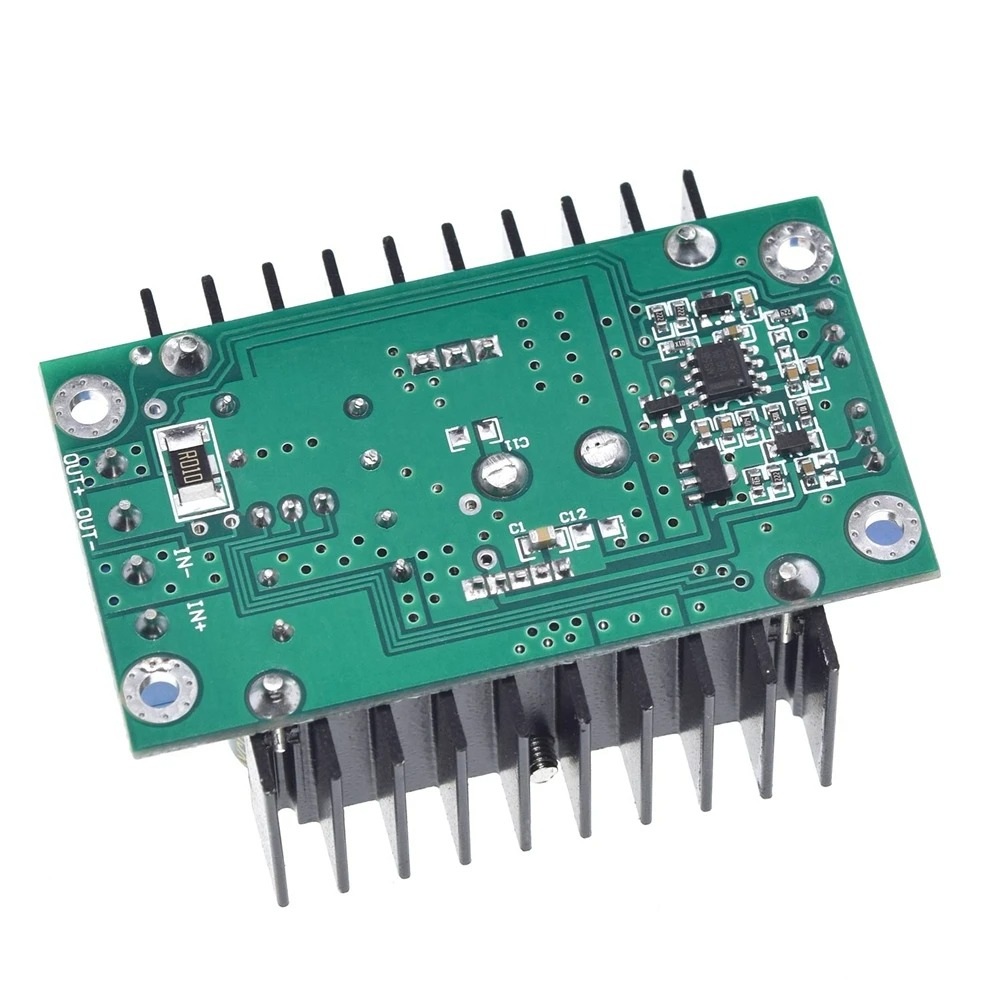
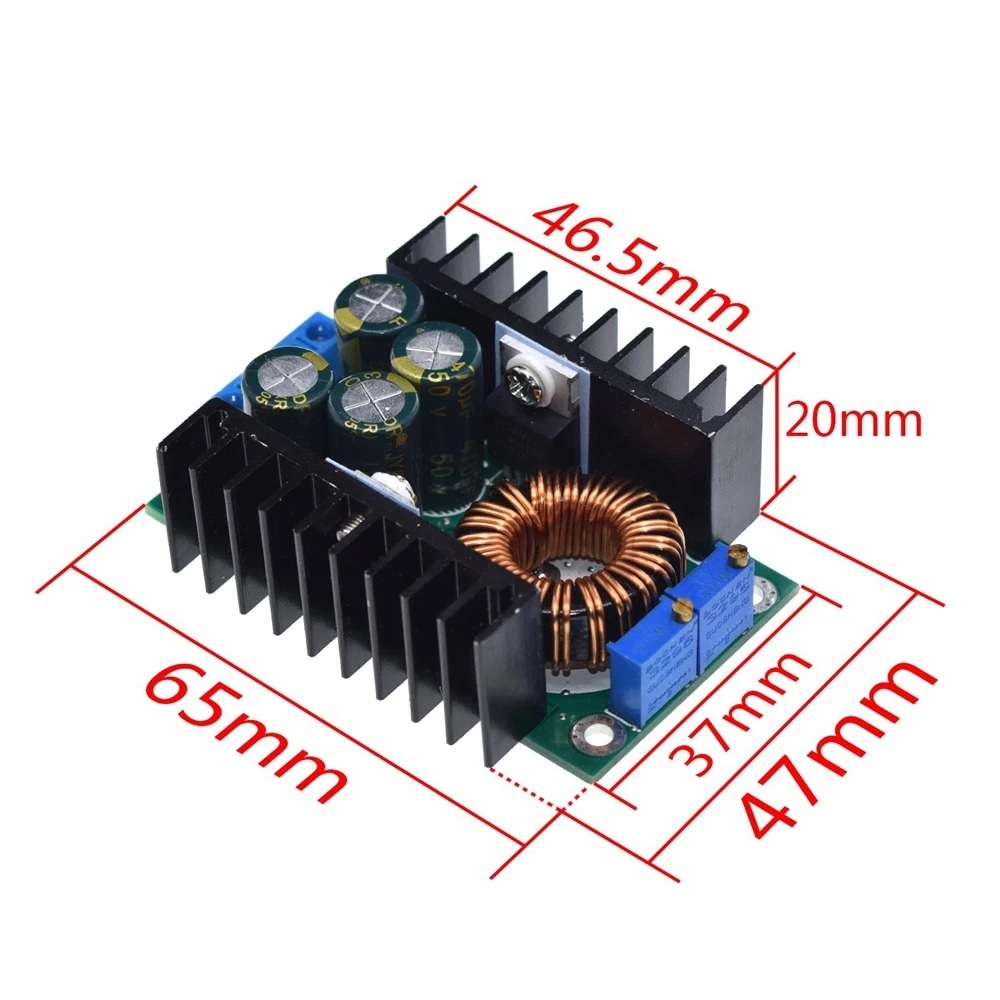
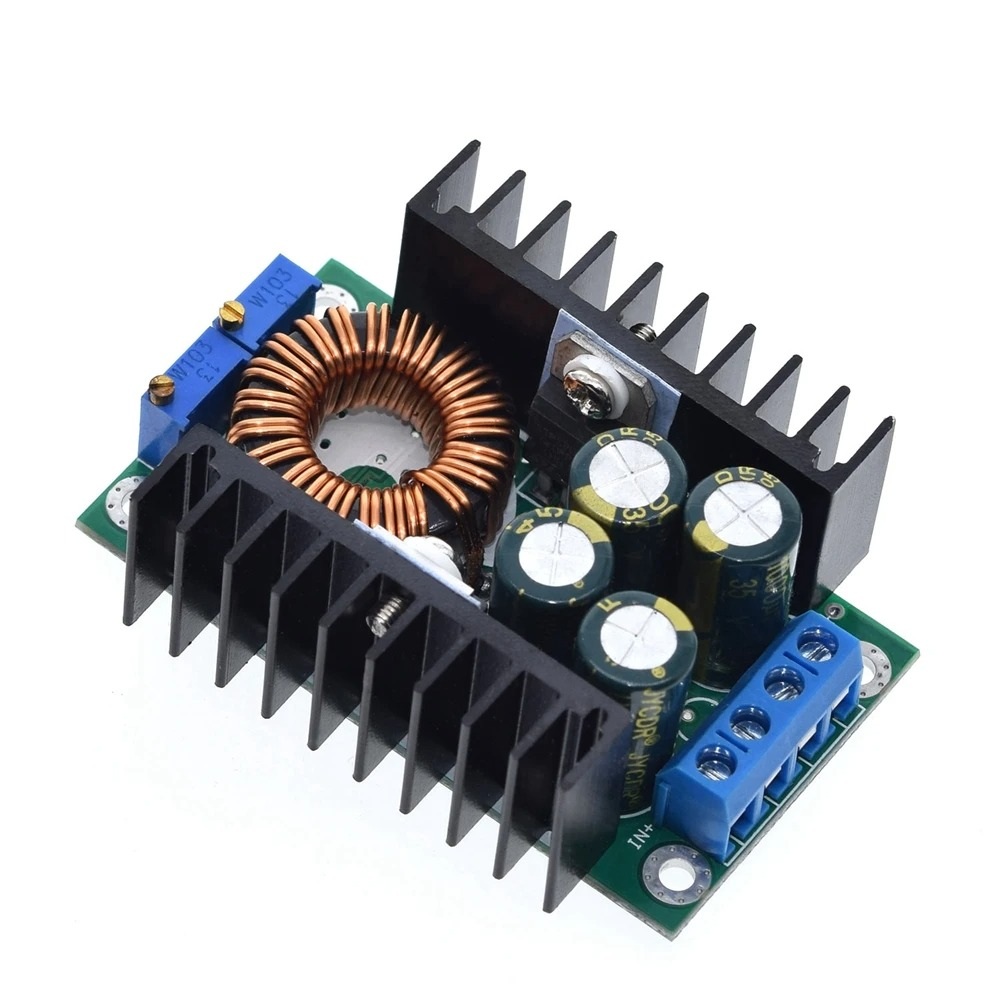
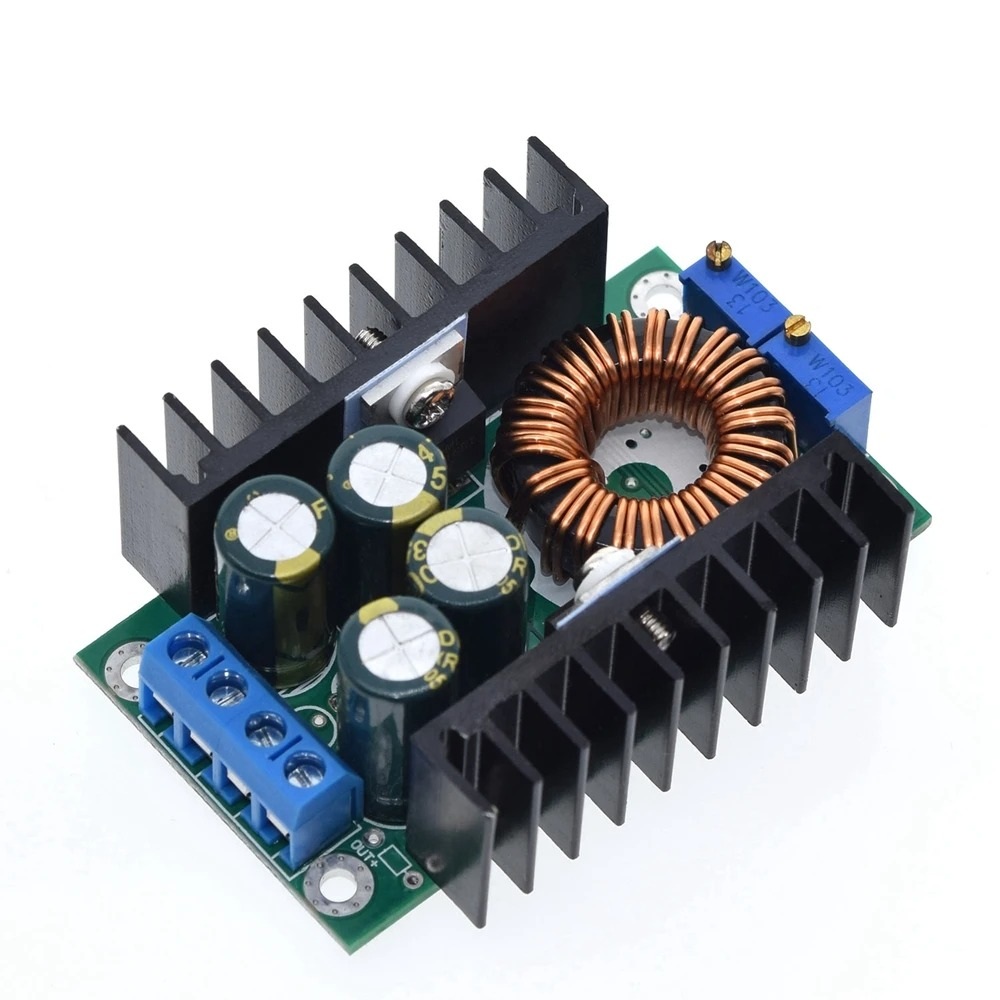
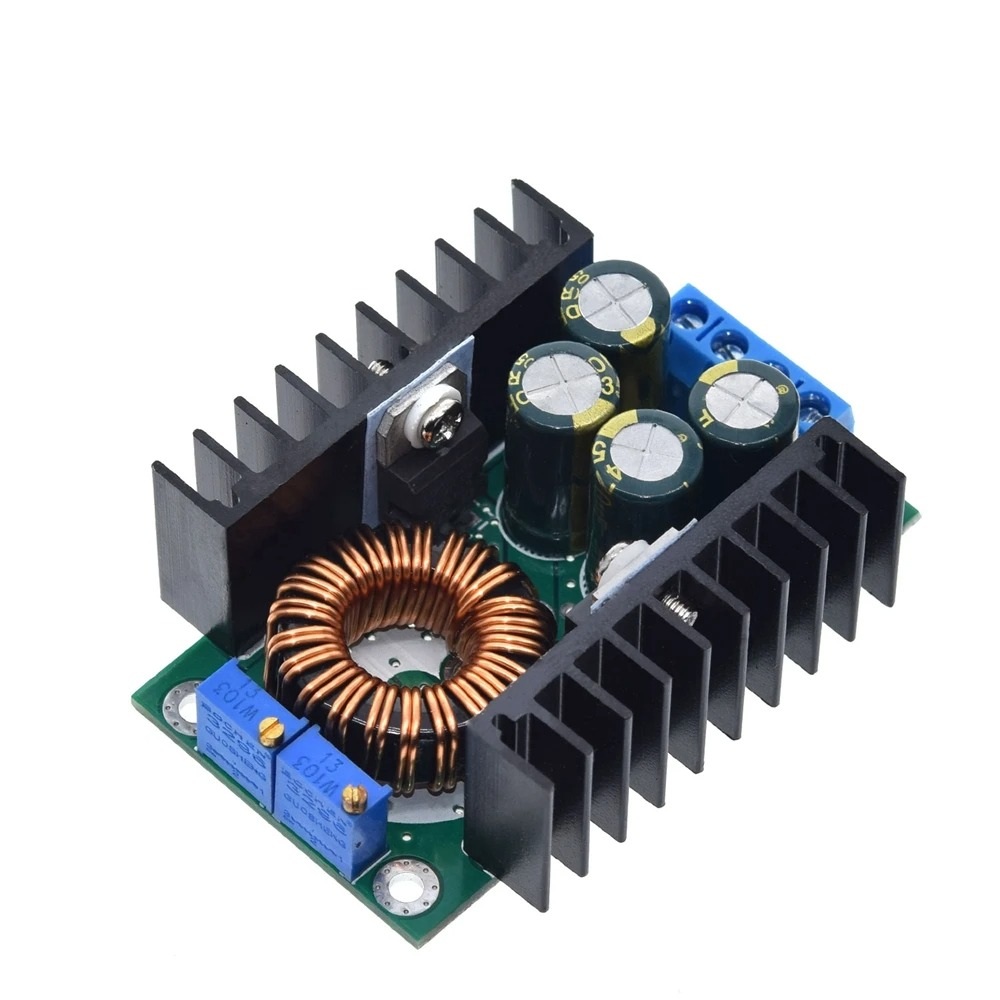
Buck 8A XL4106 with Voltage and Current Adjustment
1. Max Current: 8A
2. Topology: Step-Down (Buck)
3. Control: CV/CC with pot adjustment
4. Efficiency: Up to 92%
5. Protection: Over-temperature
The Buck 8A XL4106 is a high-current, step-down DC-DC converter module featuring adjustable output voltage and current limiting. Based on the XL4106 switching regulator IC, it efficiently converts higher input voltages to lower output voltages while delivering up to 8A of continuous current. The onboard potentiometers enable user adjustment of both the output voltage and current threshold, making it suitable for powering demanding loads where precise control is required.
This module employs a constant-voltage, constant-current (CV/CC) control mechanism, allowing it to function as a general-purpose power supply or a dedicated battery charger. The current adjustment feature provides protection against overloads, limiting the maximum current drawn by the load. Its robust design and high conversion efficiency help reduce heat dissipation, ensuring stable operation under sustained load conditions.
Maximum output current: 8A (continuous)
Adjustable output voltage via onboard potentiometer
Adjustable current limiting via onboard potentiometer
Constant voltage / constant current (CV/CC) operation
Buck 8A XL4106 with volt and current adj - Arduino Uno
Buck 8A XL4106 with volt and current adj - Arduino Nano
Buck 8A XL4106 with volt and current adj - Arduino Mega
Buck 8A XL4106 with volt and current adj - ESP32
Buck 8A XL4106 with volt and current adj - ESP8266
Buck 8A XL4106 with volt and current adj - STM32
Buck 8A XL4106 with volt and current adj - Raspberry Pi Pico
📄 File: buck_8a_xl4106_with_volt_and_current_adj_-_arduino_uno.inoArduino Uno
495 characters
1//ekostra.com
2//electronics store in egypt
3//+201008896258
4
5// Buck 8A XL4106 with volt and current adj is set with its own onboard trimmer potentiometer (a small screw you turn with a screwdriver) - it has no digital control interface, so there's nothing for a microcontroller to do here. If you need SOFTWARE-adjustable output voltage, look at a digital-potentiometer-controlled design instead (e.g. this module's feedback pin driven through a TPL0501/MCP41010).
5// Buck 8A XL4106 with volt and current adj is set with its own onboard trimmer potentiometer (a small screw you turn with a screwdriver) - it has no digital control interface, so there's nothing for a microcontroller to do here. If you need SOFTWARE-adjustable output voltage, look at a digital-potentiometer-controlled design instead (e.g. this module's feedback pin driven through a TPL0501/MCP41010).
6voidsetup() {}
7voidloop() {}
📄 File: buck_8a_xl4106_with_volt_and_current_adj_-_arduino_mega.inoArduino Mega
495 characters
1//ekostra.com
2//electronics store in egypt
3//+201008896258
4
5// Buck 8A XL4106 with volt and current adj is set with its own onboard trimmer potentiometer (a small screw you turn with a screwdriver) - it has no digital control interface, so there's nothing for a microcontroller to do here. If you need SOFTWARE-adjustable output voltage, look at a digital-potentiometer-controlled design instead (e.g. this module's feedback pin driven through a TPL0501/MCP41010).
5// Buck 8A XL4106 with volt and current adj is set with its own onboard trimmer potentiometer (a small screw you turn with a screwdriver) - it has no digital control interface, so there's nothing for a microcontroller to do here. If you need SOFTWARE-adjustable output voltage, look at a digital-potentiometer-controlled design instead (e.g. this module's feedback pin driven through a TPL0501/MCP41010).
5// Buck 8A XL4106 with volt and current adj is set with its own onboard trimmer potentiometer (a small screw you turn with a screwdriver) - it has no digital control interface, so there's nothing for a microcontroller to do here. If you need SOFTWARE-adjustable output voltage, look at a digital-potentiometer-controlled design instead (e.g. this module's feedback pin driven through a TPL0501/MCP41010).
5// Buck 8A XL4106 with volt and current adj is set with its own onboard trimmer potentiometer (a small screw you turn with a screwdriver) - it has no digital control interface, so there's nothing for a microcontroller to do here. If you need SOFTWARE-adjustable output voltage, look at a digital-potentiometer-controlled design instead (e.g. this module's feedback pin driven through a TPL0501/MCP41010).
6voidsetup() {}
7voidloop() {}
📄 File: buck_8a_xl4106_with_volt_and_current_adj_-_raspberry_pi_pico.inoRaspberry Pi Pico
495 characters
1//ekostra.com
2//electronics store in egypt
3//+201008896258
4
5// Buck 8A XL4106 with volt and current adj is set with its own onboard trimmer potentiometer (a small screw you turn with a screwdriver) - it has no digital control interface, so there's nothing for a microcontroller to do here. If you need SOFTWARE-adjustable output voltage, look at a digital-potentiometer-controlled design instead (e.g. this module's feedback pin driven through a TPL0501/MCP41010).
6voidsetup() {}
7voidloop() {}
Adjustable DC-DC converter, tuned via its own onboard trimmer pot (or has its own digital display built in) - no microcontroller interface.




 Specification


