✅ Dual H-bridge driver IC L9110S ✅ Controls 2 DC motors or 1 2-phase stepper motor ✅ Operates from 2.5V to 12V ✅ Supports up to 800mA continuous current per channel ✅ Compatible with Arduino, Raspberry Pi, and other MCUs
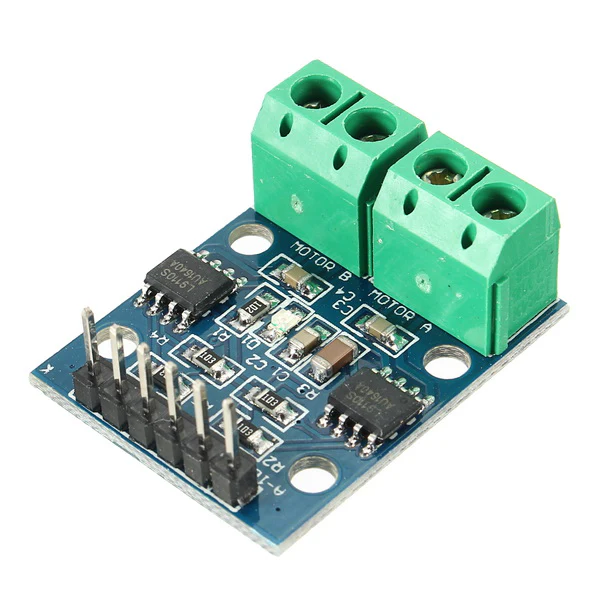
The L9110S dual-channel h-bridge motor driver module is a compact board that can be used to drive small robots. This module is based on the L9110 Motor Driver IC. This module has two independent motor driver chips which can each drive up to 800mA of continuous current. The boards can be operated from 2.5 V to 12 V enabling this module to be used with both 3.3 Volts and 5 Volts microcontrollers. A set of female header pins is used to connect this module to a microcontroller. The motors are attached via two sets of screw terminals.
A PWM Pulse Width Modulation signal is used to control the speed of a motor and a digital output is used to change its direction. This module can also be used to drive a single four-line two-phase stepper motor. Four holes make this board easy to mount onto your robot or other projects.
Instructions:
VCC external 2. 5V-12V voltage, GND external GND
IA1 external MCU 10 port
IB1 external MCU 10 port
IA2 external MCU 10 port
IB2 external MCU 10 port
0A1, 0B1 are connected to 2 pins of DC motor, no direction
0A2, 0B2 are connected to 2 pins of DC motor, no direction
Turn on VCC, the GND module power indicator is on.
IA1 input high level, IB1 input low level, [0A1 0B1] motor forward
IA1 input low level, IB1 input high level, [0A1 0B1] motor reverse
IA2 input high level, IB2 input low level, [0A2 0B2] motor forward
IA2 input low level, IB2 input high level, [0A2 0B2] motor reverse
L9110S DC Stepper Motor Driver Board HBridge - Arduino Uno
L9110S DC Stepper Motor Driver Board HBridge - Arduino Nano
L9110S DC Stepper Motor Driver Board HBridge - Arduino Mega
L9110S DC Stepper Motor Driver Board HBridge - ESP32
L9110S DC Stepper Motor Driver Board HBridge - ESP8266
L9110S DC Stepper Motor Driver Board HBridge - STM32
L9110S DC Stepper Motor Driver Board HBridge - Raspberry Pi Pico
📄 File: l9110s_dc_stepper_motor_driver_board_hbridge_-_arduino_uno.inoArduino Uno
868 characters
1//ekostra.com
2//electronics store in egypt
3//+201008896258
4
5// L9110S: IN1=8, IN2=9, ENA(PWM speed)=10 on Arduino Uno. Motor's own power (up to several amps) comes from a separate supply into the driver board, never from the microcontroller pin.
5// L9110S: IN1=8, IN2=9, ENA(PWM speed)=10 on Arduino Nano. Motor's own power (up to several amps) comes from a separate supply into the driver board, never from the microcontroller pin.
6#define IN1 8
7#define IN2 9
8#define ENA 10
9
10voidsetup() {
11Serial.begin(115200);
12pinMode(IN1, OUTPUT);
13pinMode(IN2, OUTPUT);
14pinMode(ENA, OUTPUT);
15}
16
17void driveForward(int speed) { // speed 0-255
18digitalWrite(IN1, HIGH);
19digitalWrite(IN2, LOW);
20 analogWrite(ENA, speed);
21}
22
23void driveReverse(int speed) {
24digitalWrite(IN1, LOW);
25digitalWrite(IN2, HIGH);
26 analogWrite(ENA, speed);
27}
28
29void stopMotor() {
30digitalWrite(IN1, LOW);
31digitalWrite(IN2, LOW);
32}
33
34voidloop() {
35 driveForward(200);
36delay(2000);
37 stopMotor();
38delay(500);
39 driveReverse(200);
40delay(2000);
41 stopMotor();
42delay(500);
43}
📄 File: l9110s_dc_stepper_motor_driver_board_hbridge_-_arduino_mega.inoArduino Mega
869 characters
1//ekostra.com
2//electronics store in egypt
3//+201008896258
4
5// L9110S: IN1=8, IN2=9, ENA(PWM speed)=10 on Arduino Mega. Motor's own power (up to several amps) comes from a separate supply into the driver board, never from the microcontroller pin.
5// L9110S: IN1=26, IN2=27, ENA(PWM speed)=25 on ESP32. Motor's own power (up to several amps) comes from a separate supply into the driver board, never from the microcontroller pin.
5// L9110S: IN1=D5, IN2=D6, ENA(PWM speed)=D7 on ESP8266. Motor's own power (up to several amps) comes from a separate supply into the driver board, never from the microcontroller pin.
5// L9110S: IN1=PB0, IN2=PB1, ENA(PWM speed)=PA8 on STM32. Motor's own power (up to several amps) comes from a separate supply into the driver board, never from the microcontroller pin.
6#define IN1 PB0
7#define IN2 PB1
8#define ENA PA8
9
10voidsetup() {
11Serial.begin(115200);
12pinMode(IN1, OUTPUT);
13pinMode(IN2, OUTPUT);
14pinMode(ENA, OUTPUT);
15}
16
17void driveForward(int speed) { // speed 0-255
18digitalWrite(IN1, HIGH);
19digitalWrite(IN2, LOW);
20 analogWrite(ENA, speed);
21}
22
23void driveReverse(int speed) {
24digitalWrite(IN1, LOW);
25digitalWrite(IN2, HIGH);
26 analogWrite(ENA, speed);
27}
28
29void stopMotor() {
30digitalWrite(IN1, LOW);
31digitalWrite(IN2, LOW);
32}
33
34voidloop() {
35 driveForward(200);
36delay(2000);
37 stopMotor();
38delay(500);
39 driveReverse(200);
40delay(2000);
41 stopMotor();
42delay(500);
43}
📄 File: l9110s_dc_stepper_motor_driver_board_hbridge_-_raspberry_pi_pico.inoRaspberry Pi Pico
878 characters
1//ekostra.com
2//electronics store in egypt
3//+201008896258
4
5// L9110S: IN1=14, IN2=15, ENA(PWM speed)=16 on Raspberry Pi Pico. Motor's own power (up to several amps) comes from a separate supply into the driver board, never from the microcontroller pin.
6#define IN1 14
7#define IN2 15
8#define ENA 16
9
10voidsetup() {
11Serial.begin(115200);
12pinMode(IN1, OUTPUT);
13pinMode(IN2, OUTPUT);
14pinMode(ENA, OUTPUT);
15}
16
17void driveForward(int speed) { // speed 0-255
18digitalWrite(IN1, HIGH);
19digitalWrite(IN2, LOW);
20 analogWrite(ENA, speed);
21}
22
23void driveReverse(int speed) {
24digitalWrite(IN1, LOW);
25digitalWrite(IN2, HIGH);
26 analogWrite(ENA, speed);
27}
28
29void stopMotor() {
30digitalWrite(IN1, LOW);
31digitalWrite(IN2, LOW);
32}
33
34voidloop() {
35 driveForward(200);
36delay(2000);
37 stopMotor();
38delay(500);
39 driveReverse(200);
40delay(2000);
41 stopMotor();
42delay(500);
43}
Small dual H-bridge for lighter loads - same IN/EN control scheme.
Specification
Specification
WeightWeight
40 g
Dimensions
4,5 × 2 × 1 cm
Type
Dual H-Bridge Motor Driver
Model
L9110S
Operating Voltage
2.5–12 V DC
Output Current
800 mA per channel (continuous)
Peak Current
1.5 A per channel (typical)
Channels
2 (Dual H-Bridge)
Motor Type
DC Motors, Small Stepper Motors
Control Interface
Logic Level Input (IN1, IN2, IN3, IN4)
Operating Temperature
-20°C to +75°C
Mounting Type
Through-Hole / PCB
Applications
Robotics, Arduino Projects, DIY Motor Control, Small Robotics Vehicles




 Specification


