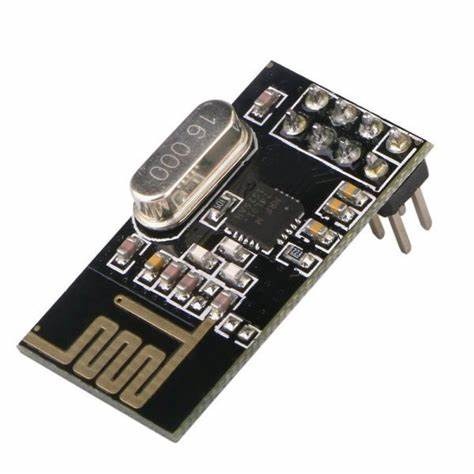
2.4GHz Wireless Transceiver nRF 24L01 (85 meter)

✅ Frequency: 2.4GHz ISM Band (Worldwide Compatibility)
✅ Range: Up to 85 meters (open space, with external antenna)
✅ Data Rate: 250kbps, 1Mbps, or 2Mbps (adjustable)
✅ Low Power Consumption: Suitable for battery-operated devices
✅ SPI Interface: Easy integration with microcontrollers
✅ 6 Data Pipes: Enables multiple communication channels
✅ Compact Size: Lightweight and easy to embed in projects
✅ Supply Voltage: 1.9V to 3.6V (3.3V recommended)
✅ ShockBurst™ Technology: Automatic packet handling for efficient transmission

Apple Shopping Event

Hurry and get discounts on all Apple devices up to 20%

65,00 EGP

8 People watching this product now!

Payment Methods:

Description

The nRF24L01 is a low-power, highly integrated 2.4GHz wireless transceiver from Nordic Semiconductor. It’s often used in short-range wireless communication applications like IoT, sensor networks, and wireless data transmission.

Here are the key specifications:

  • Frequency Range: 2.4 GHz ISM (Industrial, Scientific, and Medical) band
  • Modulation Type: GFSK (Gaussian Frequency Shift Keying)
  • Data Rate:
    • 250 kbps, 1 Mbps, and 2 Mbps selectable
  • Range:
    • Typically up to 85 meters in open space with a standard antenna (range can vary depending on environmental factors and antenna quality).
  • Power Supply Voltage:
    • 1.9V to 3.6V DC (operates with 3.3V most commonly)
  • Transmit Power:
    • +0 dBm (1 mW) to -18 dBm, adjustable for power savings and range optimization.
  • Receiver Sensitivity:
    • -94 dBm at 2 Mbps, -90 dBm at 1 Mbps (depending on data rate and conditions)
  • Current Consumption:
    • TX (Transmit mode): 11.3 mA (at +0 dBm)
    • RX (Receive mode): 13.5 mA
    • Standby mode: 26 µA
  • Antenna Type: PCB antenna or external antenna (if using the nRF24L01+ with an external antenna)
  • Interfaces:
    • SPI (Serial Peripheral Interface): Used to communicate with microcontrollers like Arduino, Raspberry Pi, etc.
  • Built-in Features:
    • Auto acknowledgment and retransmission
    • Data pipe (supports multiple communication channels)
    • Low power consumption for battery-powered devices
    • FIFO buffer for both transmission and reception
    • CRC (Cyclic Redundancy Check) for error detection
  • Form Factor: Compact 12-pin package (or in a module like the nRF24L01+ with external antenna).

Applications:

  • Wireless sensors and actuators
  • IoT (Internet of Things) devices
  • Remote controls
  • Wireless data transmission (such as in robotics or home automation)

The nRF24L01 is widely used due to its low power consumption, reliable communication, and compatibility with many microcontrollers (like Arduino). The range (85 meters) can be extended by using an external antenna version of the module (nRF24L01+).

🔌
Pin Connections
1 Table
Pin Connections Table 1
BoardSensor PinConnection
nRF24L01VCC/GND/CE/CSN3.3V only / GND / board digital pin / board digital pin
📟
2.4GHz Wireless Transceiver nRF 24L01 (85 meter) (2)
7 Examples • C/C++ | Boards: Arduino Uno, Arduino Nano, Arduino Mega, ESP32, ESP8266, STM32, Raspberry Pi Pico
2.4GHz Wireless Transceiver nRF 24L01 (85 meter) (2) - Arduino Uno
2.4GHz Wireless Transceiver nRF 24L01 (85 meter) (2) - Arduino Nano
2.4GHz Wireless Transceiver nRF 24L01 (85 meter) (2) - Arduino Mega
2.4GHz Wireless Transceiver nRF 24L01 (85 meter) (2) - ESP32
2.4GHz Wireless Transceiver nRF 24L01 (85 meter) (2) - ESP8266
2.4GHz Wireless Transceiver nRF 24L01 (85 meter) (2) - STM32
2.4GHz Wireless Transceiver nRF 24L01 (85 meter) (2) - Raspberry Pi Pico
📄 File: 2.4ghz_wireless_transceiver_nrf_24l01_(85_meter)_(2)_-_arduino_uno.inoArduino Uno
499 characters
1//ekostra.com
2//electronics store in egypt
3//+201008896258
4
5// CE=9, CSN=10 on Arduino Uno (MOSI/MISO/SCK use the board's default hardware SPI pins)
6#include <SPI.h>
7#include <RF24.h>
8
9RF24 radio(9, 10);
10const byte address[6] = "1Node";
11
12void setup() {
13 Serial.begin(115200);
14 radio.begin();
15 radio.openWritingPipe(address);
16 radio.setPALevel(RF24_PA_LOW);
17 radio.stopListening();
18}
19
20void loop() {
21 const char text[] = "Hello from Ekostra";
22 radio.write(&text, sizeof(text));
23 delay(1000);
24}
📄 File: 2.4ghz_wireless_transceiver_nrf_24l01_(85_meter)_(2)_-_arduino_nano.inoArduino Nano
500 characters
1//ekostra.com
2//electronics store in egypt
3//+201008896258
4
5// CE=9, CSN=10 on Arduino Nano (MOSI/MISO/SCK use the board's default hardware SPI pins)
6#include <SPI.h>
7#include <RF24.h>
8
9RF24 radio(9, 10);
10const byte address[6] = "1Node";
11
12void setup() {
13 Serial.begin(115200);
14 radio.begin();
15 radio.openWritingPipe(address);
16 radio.setPALevel(RF24_PA_LOW);
17 radio.stopListening();
18}
19
20void loop() {
21 const char text[] = "Hello from Ekostra";
22 radio.write(&text, sizeof(text));
23 delay(1000);
24}
📄 File: 2.4ghz_wireless_transceiver_nrf_24l01_(85_meter)_(2)_-_arduino_mega.inoArduino Mega
500 characters
1//ekostra.com
2//electronics store in egypt
3//+201008896258
4
5// CE=9, CSN=10 on Arduino Mega (MOSI/MISO/SCK use the board's default hardware SPI pins)
6#include <SPI.h>
7#include <RF24.h>
8
9RF24 radio(9, 10);
10const byte address[6] = "1Node";
11
12void setup() {
13 Serial.begin(115200);
14 radio.begin();
15 radio.openWritingPipe(address);
16 radio.setPALevel(RF24_PA_LOW);
17 radio.stopListening();
18}
19
20void loop() {
21 const char text[] = "Hello from Ekostra";
22 radio.write(&text, sizeof(text));
23 delay(1000);
24}
📄 File: 2.4ghz_wireless_transceiver_nrf_24l01_(85_meter)_(2)_-_esp32.inoESP32
491 characters
1//ekostra.com
2//electronics store in egypt
3//+201008896258
4
5// CE=4, CSN=5 on ESP32 (MOSI/MISO/SCK use the board's default hardware SPI pins)
6#include <SPI.h>
7#include <RF24.h>
8
9RF24 radio(4, 5);
10const byte address[6] = "1Node";
11
12void setup() {
13 Serial.begin(115200);
14 radio.begin();
15 radio.openWritingPipe(address);
16 radio.setPALevel(RF24_PA_LOW);
17 radio.stopListening();
18}
19
20void loop() {
21 const char text[] = "Hello from Ekostra";
22 radio.write(&text, sizeof(text));
23 delay(1000);
24}
📄 File: 2.4ghz_wireless_transceiver_nrf_24l01_(85_meter)_(2)_-_esp8266.inoESP8266
497 characters
1//ekostra.com
2//electronics store in egypt
3//+201008896258
4
5// CE=D3, CSN=D8 on ESP8266 (MOSI/MISO/SCK use the board's default hardware SPI pins)
6#include <SPI.h>
7#include <RF24.h>
8
9RF24 radio(D3, D8);
10const byte address[6] = "1Node";
11
12void setup() {
13 Serial.begin(115200);
14 radio.begin();
15 radio.openWritingPipe(address);
16 radio.setPALevel(RF24_PA_LOW);
17 radio.stopListening();
18}
19
20void loop() {
21 const char text[] = "Hello from Ekostra";
22 radio.write(&text, sizeof(text));
23 delay(1000);
24}
📄 File: 2.4ghz_wireless_transceiver_nrf_24l01_(85_meter)_(2)_-_stm32.inoSTM32
499 characters
1//ekostra.com
2//electronics store in egypt
3//+201008896258
4
5// CE=PB0, CSN=PA4 on STM32 (MOSI/MISO/SCK use the board's default hardware SPI pins)
6#include <SPI.h>
7#include <RF24.h>
8
9RF24 radio(PB0, PA4);
10const byte address[6] = "1Node";
11
12void setup() {
13 Serial.begin(115200);
14 radio.begin();
15 radio.openWritingPipe(address);
16 radio.setPALevel(RF24_PA_LOW);
17 radio.stopListening();
18}
19
20void loop() {
21 const char text[] = "Hello from Ekostra";
22 radio.write(&text, sizeof(text));
23 delay(1000);
24}
📄 File: 2.4ghz_wireless_transceiver_nrf_24l01_(85_meter)_(2)_-_raspberry_pi_pico.inoRaspberry Pi Pico
507 characters
1//ekostra.com
2//electronics store in egypt
3//+201008896258
4
5// CE=20, CSN=17 on Raspberry Pi Pico (MOSI/MISO/SCK use the board's default hardware SPI pins)
6#include <SPI.h>
7#include <RF24.h>
8
9RF24 radio(20, 17);
10const byte address[6] = "1Node";
11
12void setup() {
13 Serial.begin(115200);
14 radio.begin();
15 radio.openWritingPipe(address);
16 radio.setPALevel(RF24_PA_LOW);
17 radio.stopListening();
18}
19
20void loop() {
21 const char text[] = "Hello from Ekostra";
22 radio.write(&text, sizeof(text));
23 delay(1000);
24}
SPI 2.4GHz transceiver.

Specification

Specification

WeightWeight8 g
Dimensions3 × 2 × 1 cm
operating-voltage1.9V – 3.6V (3.3V recommended)
current-consumption~12mA (TX), ~13.5mA (RX)
operating-temperature -40°C to +85°C
modulationGFSK (Gaussian Frequency Shift Keying)
number-of-channels125 (programmable)
error-detectionCRC (Cyclic Redundancy Check)

Customer Reviews