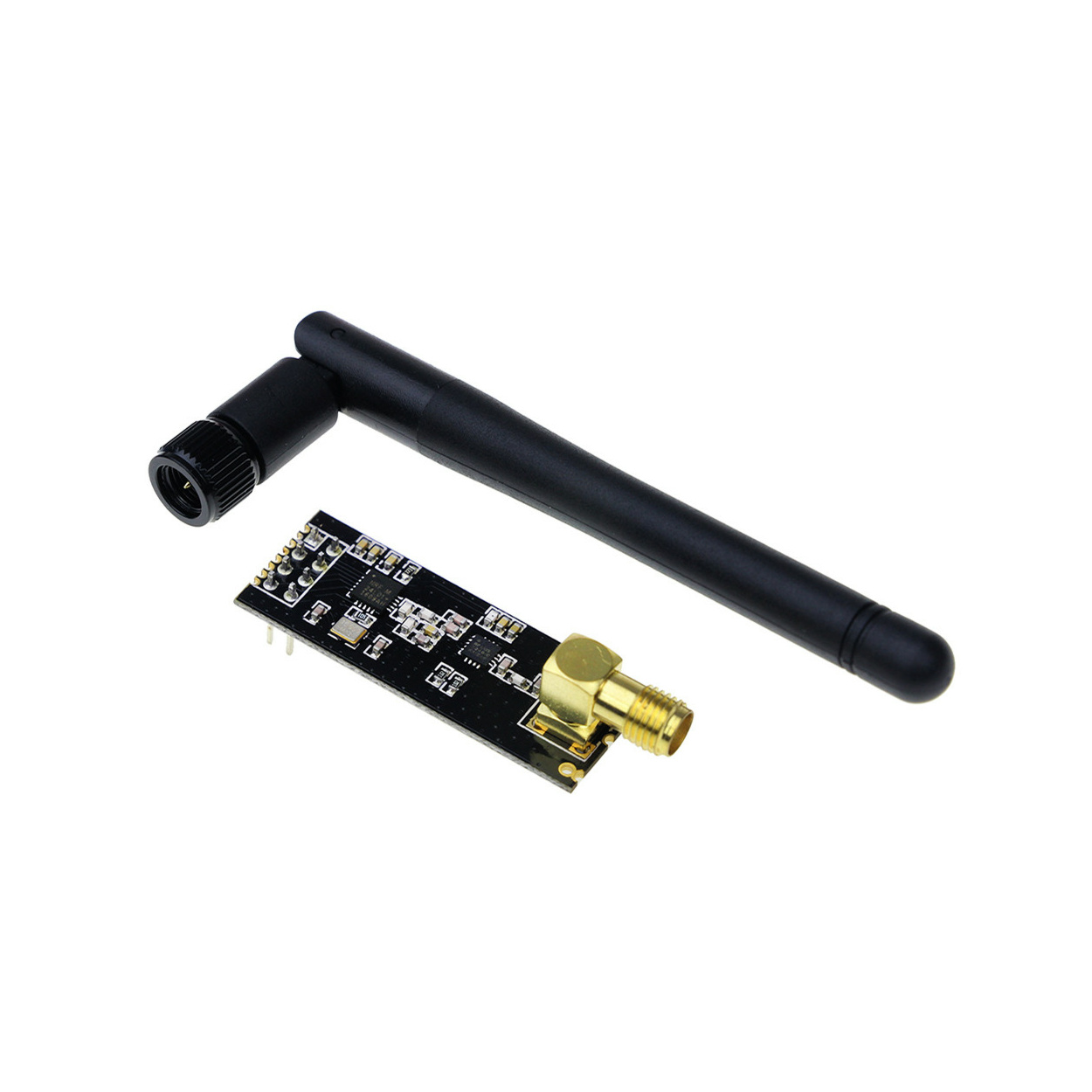
The NRF24L01 Wireless Module with Antenna is a high-performance RF transceiver designed for 2.4GHz wireless communication . It features an external PA (Power Amplifier) and LNA (Low Noise Amplifier) for extended range and improved signal strength , making it ideal for long-distance applications.
This module offers ultra-low power consumption , high-speed data transfer (up to 2Mbps), and error detection features for reliable communication. It is widely used in IoT projects, wireless sensor networks, RC systems, and industrial automation .
Key Features: ✅ Long-Range Communication – External antenna enhances signal strength2.4GHz RF Transceiver – Supports multiple communication channelsHigh-Speed Data Transfer – Up to 2Mbps for fast communicationLow Power Consumption – Ideal for battery-powered applicationsSPI Interface – Easy integration with Arduino, Raspberry Pi, ESP8266, and moreEnhanced Signal Stability – PA & LNA boost performance in noisy environments
Specifications:
Model: NRF24L01+ with PA & LNAFrequency: 2.4GHz ISM BandData Rate: 250kbps, 1Mbps, 2MbpsOperating Voltage: 3.3VCommunication Interface: SPIAntenna: External 2dBi antennaRange: Up to 1000m (line of sight)Power Consumption: Ultra-low power designError Handling: Automatic packet handling, CRC error detection
Applications: 🔹 IoT & Smart Devices – Wireless sensor networks and home automationRobotics & Drones – Reliable communication for remote control systemsIndustrial Automation – Long-range, stable RF communicationRC Vehicles & Remote Controllers – Enhanced wireless range and stability
Pin Connections Table 1
Board Sensor Pin Connection nRF24L01+PA+LNA VCC/GND/CE/CSN 3.3V only / GND / board digital pin / board digital pin
NRF24L01 Wireless Module With Antenna - Arduino Uno
NRF24L01 Wireless Module With Antenna - Arduino Nano
NRF24L01 Wireless Module With Antenna - Arduino Mega
NRF24L01 Wireless Module With Antenna - ESP32
NRF24L01 Wireless Module With Antenna - ESP8266
NRF24L01 Wireless Module With Antenna - STM32
NRF24L01 Wireless Module With Antenna - Raspberry Pi Pico
1 //ekostra.com
2 //electronics store in egypt
3 //+201008896258
4
5 // CE=9 , CSN=10 on Arduino Uno (MOSI/MISO/SCK use the board's default hardware SPI pins)
6 #include <SPI.h>
7 #include <RF24.h>
8
9 RF24 radio(9 , 10 );
10 const byte address[6 ] = "1Node";
11
12 void setup () {
13 Serial.begin (115200 );
14 radio.begin();
15 radio.openWritingPipe(address);
16 radio.setPALevel(RF24_PA_LOW);
17 radio.stopListening();
18 }
19
20 void loop () {
21 const char text[] = "Hello from Ekostra";
22 radio.write(&text, sizeof(text));
23 delay (1000 );
24 }
1 //ekostra.com
2 //electronics store in egypt
3 //+201008896258
4
5 // CE=9 , CSN=10 on Arduino Nano (MOSI/MISO/SCK use the board's default hardware SPI pins)
6 #include <SPI.h>
7 #include <RF24.h>
8
9 RF24 radio(9 , 10 );
10 const byte address[6 ] = "1Node";
11
12 void setup () {
13 Serial.begin (115200 );
14 radio.begin();
15 radio.openWritingPipe(address);
16 radio.setPALevel(RF24_PA_LOW);
17 radio.stopListening();
18 }
19
20 void loop () {
21 const char text[] = "Hello from Ekostra";
22 radio.write(&text, sizeof(text));
23 delay (1000 );
24 }
1 //ekostra.com
2 //electronics store in egypt
3 //+201008896258
4
5 // CE=9 , CSN=10 on Arduino Mega (MOSI/MISO/SCK use the board's default hardware SPI pins)
6 #include <SPI.h>
7 #include <RF24.h>
8
9 RF24 radio(9 , 10 );
10 const byte address[6 ] = "1Node";
11
12 void setup () {
13 Serial.begin (115200 );
14 radio.begin();
15 radio.openWritingPipe(address);
16 radio.setPALevel(RF24_PA_LOW);
17 radio.stopListening();
18 }
19
20 void loop () {
21 const char text[] = "Hello from Ekostra";
22 radio.write(&text, sizeof(text));
23 delay (1000 );
24 }
1 //ekostra.com
2 //electronics store in egypt
3 //+201008896258
4
5 // CE=4 , CSN=5 on ESP32 (MOSI/MISO/SCK use the board's default hardware SPI pins)
6 #include <SPI.h>
7 #include <RF24.h>
8
9 RF24 radio(4 , 5 );
10 const byte address[6 ] = "1Node";
11
12 void setup () {
13 Serial.begin (115200 );
14 radio.begin();
15 radio.openWritingPipe(address);
16 radio.setPALevel(RF24_PA_LOW);
17 radio.stopListening();
18 }
19
20 void loop () {
21 const char text[] = "Hello from Ekostra";
22 radio.write(&text, sizeof(text));
23 delay (1000 );
24 }
1 //ekostra.com
2 //electronics store in egypt
3 //+201008896258
4
5 // CE=D3, CSN=D8 on ESP8266 (MOSI/MISO/SCK use the board's default hardware SPI pins)
6 #include <SPI.h>
7 #include <RF24.h>
8
9 RF24 radio(D3, D8);
10 const byte address[6 ] = "1Node";
11
12 void setup () {
13 Serial.begin (115200 );
14 radio.begin();
15 radio.openWritingPipe(address);
16 radio.setPALevel(RF24_PA_LOW);
17 radio.stopListening();
18 }
19
20 void loop () {
21 const char text[] = "Hello from Ekostra";
22 radio.write(&text, sizeof(text));
23 delay (1000 );
24 }
1 //ekostra.com
2 //electronics store in egypt
3 //+201008896258
4
5 // CE=PB0, CSN=PA4 on STM32 (MOSI/MISO/SCK use the board's default hardware SPI pins)
6 #include <SPI.h>
7 #include <RF24.h>
8
9 RF24 radio(PB0, PA4);
10 const byte address[6 ] = "1Node";
11
12 void setup () {
13 Serial.begin (115200 );
14 radio.begin();
15 radio.openWritingPipe(address);
16 radio.setPALevel(RF24_PA_LOW);
17 radio.stopListening();
18 }
19
20 void loop () {
21 const char text[] = "Hello from Ekostra";
22 radio.write(&text, sizeof(text));
23 delay (1000 );
24 }
1 //ekostra.com
2 //electronics store in egypt
3 //+201008896258
4
5 // CE=20 , CSN=17 on Raspberry Pi Pico (MOSI/MISO/SCK use the board's default hardware SPI pins)
6 #include <SPI.h>
7 #include <RF24.h>
8
9 RF24 radio(20 , 17 );
10 const byte address[6 ] = "1Node";
11
12 void setup () {
13 Serial.begin (115200 );
14 radio.begin();
15 radio.openWritingPipe(address);
16 radio.setPALevel(RF24_PA_LOW);
17 radio.stopListening();
18 }
19
20 void loop () {
21 const char text[] = "Hello from Ekostra";
22 radio.write(&text, sizeof(text));
23 delay (1000 );
24 }
Project Notes: Long-range nRF24L01+PA+LNA variant - same SPI wiring/code as a standard nRF24L01.




 Specification


