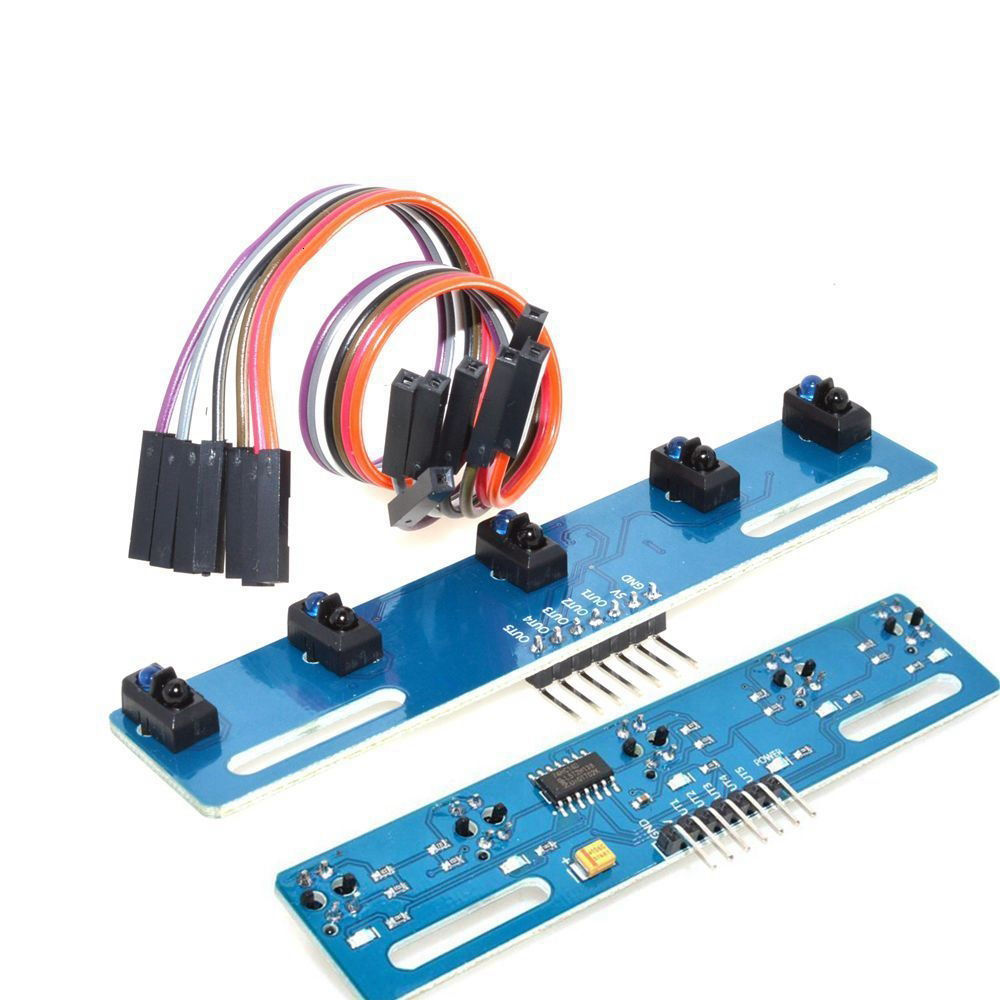
TCRT5000L 5 Channel Tracking Sensor Tracking Module Infrared Sensor is based on the TRCT5000 infrared reflection sensor, it is often used to make tracking smart cars. The infrared emitting diode of the TRCT5000 sensor continuously emits infrared rays. When the emitted infrared rays are reflected by the object, they are received by the infrared receiver and output analogue values. The output analogue value is related to the object distance and the colour of the object. The position of the tracking line is judged by calculating the analogue value of the five outputs.
Connection:
VCC: VCC is the power input port, which could access 3.3V ~ 5V voltage
GND: GND is the negative input of the power supply
OUT1 ~ 5:OUT is the signal output port, MCU link I / O port
Features:
Applicable to a variety of platforms including for Arduino /AVR/ARM/PIC High-Quality Tracker Sensor The module is a convenient carrier for eight IR emitter and receiver pairs evenly paced.
Distance between each IR Sensor: 15mm
Uses 5 sensors for best resolution
Great useful in building fast line following and grid navigating robots
Comes with easy to use digital outputs with a direct connection to microcontrollers
The array has mounting holes of 3mm diameter for easy mounting
Status LED on each sensor for the detection of black line
Package Includes: 1 x TCRT5000L 5 Channel Tracking Sensor Tracking Module Infrared Sensor
Pin Connections Table 1
Board Sensor Pin Connection Line Array VCC/GND/OUT1-5 3.3-5V / GND / 5 board digital pins
TCRT5000L 5 Channel Tracking Sensor Tracking Module Infrared Sensor - Arduino Uno
TCRT5000L 5 Channel Tracking Sensor Tracking Module Infrared Sensor - Arduino Nano
TCRT5000L 5 Channel Tracking Sensor Tracking Module Infrared Sensor - Arduino Mega
TCRT5000L 5 Channel Tracking Sensor Tracking Module Infrared Sensor - ESP32
TCRT5000L 5 Channel Tracking Sensor Tracking Module Infrared Sensor - ESP8266
TCRT5000L 5 Channel Tracking Sensor Tracking Module Infrared Sensor - STM32
TCRT5000L 5 Channel Tracking Sensor Tracking Module Infrared Sensor - Raspberry Pi Pico
1 //ekostra.com
2 //electronics store in egypt
3 //+201008896258
4
5 // 5 digital channel pins on Arduino Uno: 2 , 3 , 4 , 5 , 6
6 const int NUM_CHANNELS = 5 ;
7 int sensorPins[NUM_CHANNELS] = {2 , 3 , 4 , 5 , 6 };
8
9 void setup () {
10 Serial.begin (115200 );
11 for (int i = 0 ; i < NUM_CHANNELS; i++) pinMode (sensorPins[i], INPUT );
12 }
13
14 void loop () {
15 for (int i = 0 ; i < NUM_CHANNELS; i++) {
16 Serial.print (digitalRead(sensorPins[i])); // typically LOW = line detected (black surface)
17 Serial.print (" ");
18 }
19 Serial.println ();
20 delay (100 );
21 }
1 //ekostra.com
2 //electronics store in egypt
3 //+201008896258
4
5 // 5 digital channel pins on Arduino Nano: 2 , 3 , 4 , 5 , 6
6 const int NUM_CHANNELS = 5 ;
7 int sensorPins[NUM_CHANNELS] = {2 , 3 , 4 , 5 , 6 };
8
9 void setup () {
10 Serial.begin (115200 );
11 for (int i = 0 ; i < NUM_CHANNELS; i++) pinMode (sensorPins[i], INPUT );
12 }
13
14 void loop () {
15 for (int i = 0 ; i < NUM_CHANNELS; i++) {
16 Serial.print (digitalRead(sensorPins[i])); // typically LOW = line detected (black surface)
17 Serial.print (" ");
18 }
19 Serial.println ();
20 delay (100 );
21 }
1 //ekostra.com
2 //electronics store in egypt
3 //+201008896258
4
5 // 5 digital channel pins on Arduino Mega: 2 , 3 , 4 , 5 , 6
6 const int NUM_CHANNELS = 5 ;
7 int sensorPins[NUM_CHANNELS] = {2 , 3 , 4 , 5 , 6 };
8
9 void setup () {
10 Serial.begin (115200 );
11 for (int i = 0 ; i < NUM_CHANNELS; i++) pinMode (sensorPins[i], INPUT );
12 }
13
14 void loop () {
15 for (int i = 0 ; i < NUM_CHANNELS; i++) {
16 Serial.print (digitalRead(sensorPins[i])); // typically LOW = line detected (black surface)
17 Serial.print (" ");
18 }
19 Serial.println ();
20 delay (100 );
21 }
1 //ekostra.com
2 //electronics store in egypt
3 //+201008896258
4
5 // 5 digital channel pins on ESP32: 13 , 14 , 27 , 26 , 25
6 const int NUM_CHANNELS = 5 ;
7 int sensorPins[NUM_CHANNELS] = {13 , 14 , 27 , 26 , 25 };
8
9 void setup () {
10 Serial.begin (115200 );
11 for (int i = 0 ; i < NUM_CHANNELS; i++) pinMode (sensorPins[i], INPUT );
12 }
13
14 void loop () {
15 for (int i = 0 ; i < NUM_CHANNELS; i++) {
16 Serial.print (digitalRead(sensorPins[i])); // typically LOW = line detected (black surface)
17 Serial.print (" ");
18 }
19 Serial.println ();
20 delay (100 );
21 }
1 //ekostra.com
2 //electronics store in egypt
3 //+201008896258
4
5 // 5 digital channel pins on ESP8266: D0, D3, D4, D5, D6
6 const int NUM_CHANNELS = 5 ;
7 int sensorPins[NUM_CHANNELS] = {D0, D3, D4, D5, D6};
8
9 void setup () {
10 Serial.begin (115200 );
11 for (int i = 0 ; i < NUM_CHANNELS; i++) pinMode (sensorPins[i], INPUT );
12 }
13
14 void loop () {
15 for (int i = 0 ; i < NUM_CHANNELS; i++) {
16 Serial.print (digitalRead(sensorPins[i])); // typically LOW = line detected (black surface)
17 Serial.print (" ");
18 }
19 Serial.println ();
20 delay (100 );
21 }
1 //ekostra.com
2 //electronics store in egypt
3 //+201008896258
4
5 // 5 digital channel pins on STM32: PA0, PA1, PA2, PA3, PA4
6 const int NUM_CHANNELS = 5 ;
7 int sensorPins[NUM_CHANNELS] = {PA0, PA1, PA2, PA3, PA4};
8
9 void setup () {
10 Serial.begin (115200 );
11 for (int i = 0 ; i < NUM_CHANNELS; i++) pinMode (sensorPins[i], INPUT );
12 }
13
14 void loop () {
15 for (int i = 0 ; i < NUM_CHANNELS; i++) {
16 Serial.print (digitalRead(sensorPins[i])); // typically LOW = line detected (black surface)
17 Serial.print (" ");
18 }
19 Serial.println ();
20 delay (100 );
21 }
1 //ekostra.com
2 //electronics store in egypt
3 //+201008896258
4
5 // 5 digital channel pins on Raspberry Pi Pico: 10 , 11 , 12 , 13 , 14
6 const int NUM_CHANNELS = 5 ;
7 int sensorPins[NUM_CHANNELS] = {10 , 11 , 12 , 13 , 14 };
8
9 void setup () {
10 Serial.begin (115200 );
11 for (int i = 0 ; i < NUM_CHANNELS; i++) pinMode (sensorPins[i], INPUT );
12 }
13
14 void loop () {
15 for (int i = 0 ; i < NUM_CHANNELS; i++) {
16 Serial.print (digitalRead(sensorPins[i])); // typically LOW = line detected (black surface)
17 Serial.print (" ");
18 }
19 Serial.println ();
20 delay (100 );
21 }
Project Notes: 5-channel IR reflective line-tracking array.




 Specification


