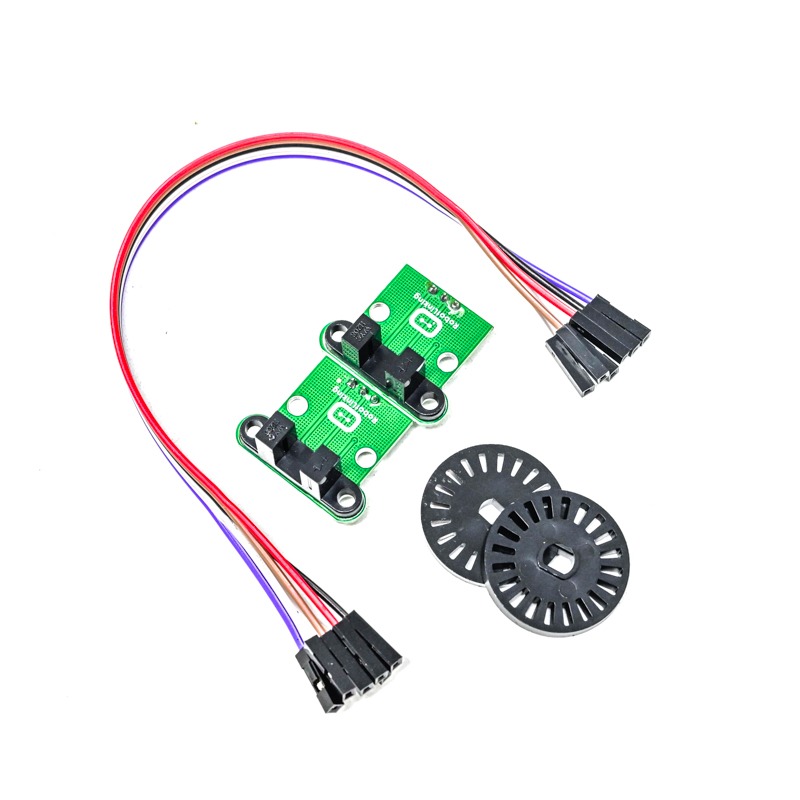
Dual-Speed Encoder with Pulse Output

  1. Working voltage: 4.5V to 5.5 V
  2. Transmit tube pressure drop: Vf = 1.6 V
  3. Transmit tube current: 20 mA
  4. Distinguish precision: 0.01 mm
  5. Measurement frequency, 100 kHz
SKU: ND038 Categories: , Tags: ,

Apple Shopping Event

Hurry and get discounts on all Apple devices up to 20%

250,00 EGP

8 People watching this product now!

Payment Methods:

Description

This speed measuring sensor is a wide voltage, high resolution, short response time, and the switch output speed measurement module. It can test the motor’s rotational speed with a black encoder (measured spec. is related to the encoder, the inner diameter of D type encoder that provided is 4mm, can be used for motor output shaft w/ 4mm diameter, which is TT motor we matched, yellow shell and white axis)


Features :

  1. Signal output: A, B two way; The TTL level
  2. Disc diameter: 24mm
  3. Inner Disc Diameter: 4 mm
  4. The encoder resolution is about 20 line
  5. Speed measuring sensor configuration: The configuration can measure 1 road motor speed

Package Includes :

1 x Double Speed Measuring Module kit

1 x Screw set

🔌
Pin Connections
1 Table
Pin Connections Table 1
BoardSensor PinConnection
EncoderVCC/GND/A/B3.3-5V / GND / board channel-A pin / board channel-B pin
📟
Dual-Speed Encoder with Pulse Output
7 Examples • C/C++ | Boards: Arduino Uno, Arduino Nano, Arduino Mega, ESP32, ESP8266, STM32, Raspberry Pi Pico
Dual-Speed Encoder with Pulse Output - Arduino Uno
Dual-Speed Encoder with Pulse Output - Arduino Nano
Dual-Speed Encoder with Pulse Output - Arduino Mega
Dual-Speed Encoder with Pulse Output - ESP32
Dual-Speed Encoder with Pulse Output - ESP8266
Dual-Speed Encoder with Pulse Output - STM32
Dual-Speed Encoder with Pulse Output - Raspberry Pi Pico
📄 File: dual-speed_encoder_with_pulse_output_-_arduino_uno.inoArduino Uno
660 characters
1//ekostra.com
2//electronics store in egypt
3//+201008896258
4
5// Channel A=2, B=3 on Arduino Uno. Both A and B need interrupt-capable pins on AVR boards (2/3 on Uno/Nano); ESP32/ESP8266/STM32/Pico support interrupts on any GPIO.
6volatile long pulseCount = 0;
7#define ENC_A 2
8#define ENC_B 3
9
10void handleEncoder() {
11 int b = digitalRead(ENC_B);
12 if (b > 0) pulseCount++; else pulseCount--;
13}
14
15void setup() {
16 Serial.begin(115200);
17 pinMode(ENC_A, INPUT_PULLUP);
18 pinMode(ENC_B, INPUT_PULLUP);
19 attachInterrupt(digitalPinToInterrupt(ENC_A), handleEncoder, RISING);
20}
21
22void loop() {
23 Serial.print("Pulse count: "); Serial.println(pulseCount);
24 delay(200);
25}
📄 File: dual-speed_encoder_with_pulse_output_-_arduino_nano.inoArduino Nano
661 characters
1//ekostra.com
2//electronics store in egypt
3//+201008896258
4
5// Channel A=2, B=3 on Arduino Nano. Both A and B need interrupt-capable pins on AVR boards (2/3 on Uno/Nano); ESP32/ESP8266/STM32/Pico support interrupts on any GPIO.
6volatile long pulseCount = 0;
7#define ENC_A 2
8#define ENC_B 3
9
10void handleEncoder() {
11 int b = digitalRead(ENC_B);
12 if (b > 0) pulseCount++; else pulseCount--;
13}
14
15void setup() {
16 Serial.begin(115200);
17 pinMode(ENC_A, INPUT_PULLUP);
18 pinMode(ENC_B, INPUT_PULLUP);
19 attachInterrupt(digitalPinToInterrupt(ENC_A), handleEncoder, RISING);
20}
21
22void loop() {
23 Serial.print("Pulse count: "); Serial.println(pulseCount);
24 delay(200);
25}
📄 File: dual-speed_encoder_with_pulse_output_-_arduino_mega.inoArduino Mega
661 characters
1//ekostra.com
2//electronics store in egypt
3//+201008896258
4
5// Channel A=2, B=3 on Arduino Mega. Both A and B need interrupt-capable pins on AVR boards (2/3 on Uno/Nano); ESP32/ESP8266/STM32/Pico support interrupts on any GPIO.
6volatile long pulseCount = 0;
7#define ENC_A 2
8#define ENC_B 3
9
10void handleEncoder() {
11 int b = digitalRead(ENC_B);
12 if (b > 0) pulseCount++; else pulseCount--;
13}
14
15void setup() {
16 Serial.begin(115200);
17 pinMode(ENC_A, INPUT_PULLUP);
18 pinMode(ENC_B, INPUT_PULLUP);
19 attachInterrupt(digitalPinToInterrupt(ENC_A), handleEncoder, RISING);
20}
21
22void loop() {
23 Serial.print("Pulse count: "); Serial.println(pulseCount);
24 delay(200);
25}
📄 File: dual-speed_encoder_with_pulse_output_-_esp32.inoESP32
658 characters
1//ekostra.com
2//electronics store in egypt
3//+201008896258
4
5// Channel A=32, B=33 on ESP32. Both A and B need interrupt-capable pins on AVR boards (2/3 on Uno/Nano); ESP32/ESP8266/STM32/Pico support interrupts on any GPIO.
6volatile long pulseCount = 0;
7#define ENC_A 32
8#define ENC_B 33
9
10void handleEncoder() {
11 int b = digitalRead(ENC_B);
12 if (b > 0) pulseCount++; else pulseCount--;
13}
14
15void setup() {
16 Serial.begin(115200);
17 pinMode(ENC_A, INPUT_PULLUP);
18 pinMode(ENC_B, INPUT_PULLUP);
19 attachInterrupt(digitalPinToInterrupt(ENC_A), handleEncoder, RISING);
20}
21
22void loop() {
23 Serial.print("Pulse count: "); Serial.println(pulseCount);
24 delay(200);
25}
📄 File: dual-speed_encoder_with_pulse_output_-_esp8266.inoESP8266
660 characters
1//ekostra.com
2//electronics store in egypt
3//+201008896258
4
5// Channel A=D5, B=D6 on ESP8266. Both A and B need interrupt-capable pins on AVR boards (2/3 on Uno/Nano); ESP32/ESP8266/STM32/Pico support interrupts on any GPIO.
6volatile long pulseCount = 0;
7#define ENC_A D5
8#define ENC_B D6
9
10void handleEncoder() {
11 int b = digitalRead(ENC_B);
12 if (b > 0) pulseCount++; else pulseCount--;
13}
14
15void setup() {
16 Serial.begin(115200);
17 pinMode(ENC_A, INPUT_PULLUP);
18 pinMode(ENC_B, INPUT_PULLUP);
19 attachInterrupt(digitalPinToInterrupt(ENC_A), handleEncoder, RISING);
20}
21
22void loop() {
23 Serial.print("Pulse count: "); Serial.println(pulseCount);
24 delay(200);
25}
📄 File: dual-speed_encoder_with_pulse_output_-_stm32.inoSTM32
662 characters
1//ekostra.com
2//electronics store in egypt
3//+201008896258
4
5// Channel A=PA0, B=PA1 on STM32. Both A and B need interrupt-capable pins on AVR boards (2/3 on Uno/Nano); ESP32/ESP8266/STM32/Pico support interrupts on any GPIO.
6volatile long pulseCount = 0;
7#define ENC_A PA0
8#define ENC_B PA1
9
10void handleEncoder() {
11 int b = digitalRead(ENC_B);
12 if (b > 0) pulseCount++; else pulseCount--;
13}
14
15void setup() {
16 Serial.begin(115200);
17 pinMode(ENC_A, INPUT_PULLUP);
18 pinMode(ENC_B, INPUT_PULLUP);
19 attachInterrupt(digitalPinToInterrupt(ENC_A), handleEncoder, RISING);
20}
21
22void loop() {
23 Serial.print("Pulse count: "); Serial.println(pulseCount);
24 delay(200);
25}
📄 File: dual-speed_encoder_with_pulse_output_-_raspberry_pi_pico.inoRaspberry Pi Pico
670 characters
1//ekostra.com
2//electronics store in egypt
3//+201008896258
4
5// Channel A=20, B=21 on Raspberry Pi Pico. Both A and B need interrupt-capable pins on AVR boards (2/3 on Uno/Nano); ESP32/ESP8266/STM32/Pico support interrupts on any GPIO.
6volatile long pulseCount = 0;
7#define ENC_A 20
8#define ENC_B 21
9
10void handleEncoder() {
11 int b = digitalRead(ENC_B);
12 if (b > 0) pulseCount++; else pulseCount--;
13}
14
15void setup() {
16 Serial.begin(115200);
17 pinMode(ENC_A, INPUT_PULLUP);
18 pinMode(ENC_B, INPUT_PULLUP);
19 attachInterrupt(digitalPinToInterrupt(ENC_A), handleEncoder, RISING);
20}
21
22void loop() {
23 Serial.print("Pulse count: "); Serial.println(pulseCount);
24 delay(200);
25}
Dual-channel pulse encoder (same quadrature counting approach as a standard rotary encoder).

Specification

Specification

WeightWeight18,0000 g
Dimensions3 × 2 × 1 cm
working-voltage4.5V to 5.5 V
transmit-tube-pressure-dropVf = 1.6 V
transmit-tube-current20 mA
distinguish-precision0.01 mm
measurement-frequency100 kHz
signal-outputA, B two way; The TTL level
disc-diameter24mm
inner-disc-diameter4 mm

Customer Reviews