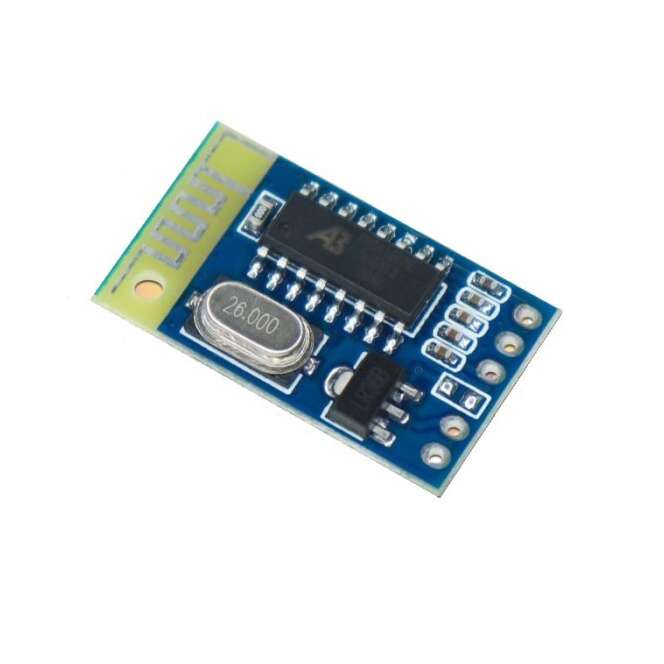
This module is a digital audio amplifier board based on the 82D05 chip, designed to deliver stable 5V digital power and high-quality sound amplification — perfect for Bluetooth speaker applications and smart audio projects.
The 82D05 5V Digital Power Channel Amplifier Bluetooth Speaker Module is engineered to provide powerful and clear stereo audio output with low power consumption. It supports dual audio channels and delivers a rich stereo experience when connected to small speaker drivers.
The module supports Bluetooth audio input, making it ideal for building custom Bluetooth speakers or integrating into portable audio systems.
Widely used in electronics projects that require clean, stable digital audio amplification, this compact and easy-to-use module is perfect for DIY electronics enthusiasts and audio system developers.
Features:
Onboard 82D05 digital amplifier chip
Bluetooth support for wireless audio input
High-quality stereo audio output
Operates on just 5V, ideal for portable systems
Compact size and easy to integrate
Simple connections for power and speaker output
Package Includes:
1 x 82D05 5V Digital Power Channel Amplifier Bluetooth Speaker Module
🔌
Pin Connections
1 Table
Pin Connections Table 1
Board
Sensor Pin
Connection
82D05
VCC/GND/TX/RX (if present)
5V / GND / board RX pin / board TX pin
📟
82D05 5V Digital Power Channel Amplifier Bluetooth Speaker Module
82D05 5V Digital Power Channel Amplifier Bluetooth Speaker Module - Arduino Uno
82D05 5V Digital Power Channel Amplifier Bluetooth Speaker Module - Arduino Nano
82D05 5V Digital Power Channel Amplifier Bluetooth Speaker Module - Arduino Mega
82D05 5V Digital Power Channel Amplifier Bluetooth Speaker Module - ESP32
82D05 5V Digital Power Channel Amplifier Bluetooth Speaker Module - ESP8266
82D05 5V Digital Power Channel Amplifier Bluetooth Speaker Module - STM32
82D05 5V Digital Power Channel Amplifier Bluetooth Speaker Module - Raspberry Pi Pico
📄 File: 82d05_5v_digital_power_channel_amplifier_bluetooth_speaker_module_-_arduino_uno.inoArduino Uno
553 characters
1//ekostra.com
2//electronics store in egypt
3//+201008896258
4
5// This module mostly runs standalone (pairs with a phone over Bluetooth, outputs to its own amplifier) - some variants expose a UART for volume/track AT-commands. RX=2, TX=3 on Arduino Uno if your specific module has that header.
5// This module mostly runs standalone (pairs with a phone over Bluetooth, outputs to its own amplifier) - some variants expose a UART for volume/track AT-commands. RX=2, TX=3 on Arduino Nano if your specific module has that header.
📄 File: 82d05_5v_digital_power_channel_amplifier_bluetooth_speaker_module_-_arduino_mega.inoArduino Mega
522 characters
1//ekostra.com
2//electronics store in egypt
3//+201008896258
4
5// This module mostly runs standalone (pairs with a phone over Bluetooth, outputs to its own amplifier) - some variants expose a UART for volume/track AT-commands. RX=19, TX=18 on Arduino Mega if your specific module has that header.
5// This module mostly runs standalone (pairs with a phone over Bluetooth, outputs to its own amplifier) - some variants expose a UART for volume/track AT-commands. RX=16, TX=17 on ESP32 if your specific module has that header.
5// This module mostly runs standalone (pairs with a phone over Bluetooth, outputs to its own amplifier) - some variants expose a UART for volume/track AT-commands. RX=D7, TX=D8 on ESP8266 if your specific module has that header.
5// This module mostly runs standalone (pairs with a phone over Bluetooth, outputs to its own amplifier) - some variants expose a UART for volume/track AT-commands. RX=PA10, TX=PA9 on STM32 if your specific module has that header.
📄 File: 82d05_5v_digital_power_channel_amplifier_bluetooth_speaker_module_-_raspberry_pi_pico.inoRaspberry Pi Pico
525 characters
1//ekostra.com
2//electronics store in egypt
3//+201008896258
4
5// This module mostly runs standalone (pairs with a phone over Bluetooth, outputs to its own amplifier) - some variants expose a UART for volume/track AT-commands. RX=1, TX=0 on Raspberry Pi Pico if your specific module has that header.




 Specification


