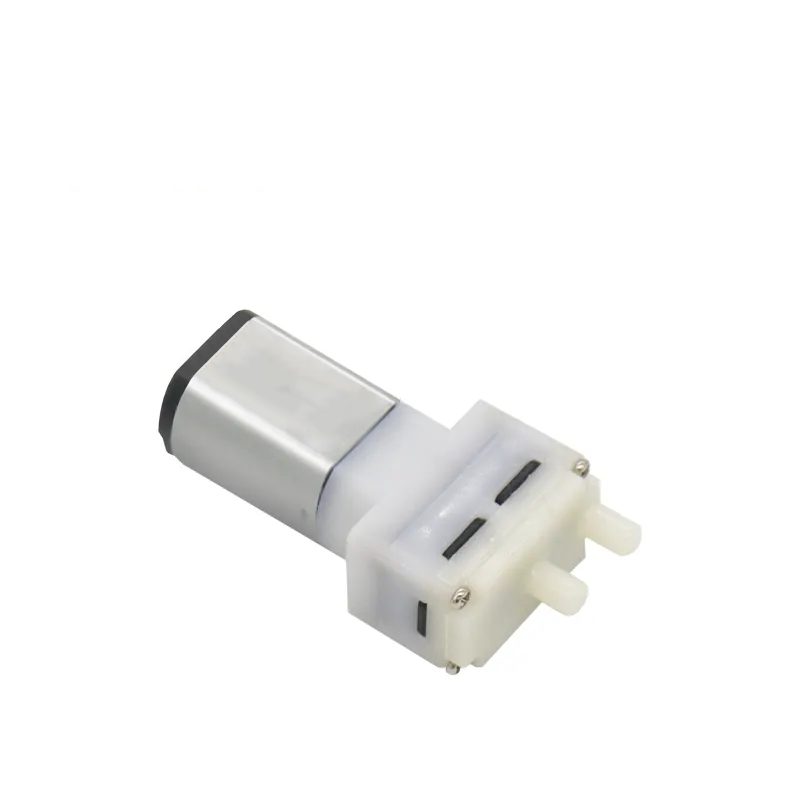
The Vacuum Negative Pressure Pump is a compact, lightweight device designed to generate suction for small-scale applications. Operating at 3.7 V and capable of delivering a flow rate of 1 L/min, it is ideal for projects requiring precise vacuum or negative pressure control. Its small form factor and low power consumption make it suitable for portable devices, laboratory experiments, and DIY or robotics applications.
Features:
Compact and lightweight design for easy integration
Low voltage operation at 3.7 V
Generates vacuum/negative pressure for small applications
Flow rate of approximately 1 L/min
Quiet and efficient operation
Suitable for continuous or intermittent use
Specifications:
Model: Vacuum Negative Pressure Pump
Operating Voltage: 3.7 V DC
Flow Rate: 1 L/min
Type: Miniature vacuum pump
Power: Low (exact wattage varies by model)
Noise Level: Low
Dimensions: 50 × 25 × 30 mm (approx.)
Weight: 40 g (approx.)
Applications:
Small suction or vacuum systems in hobbyist projects
Portable vacuum devices
DIY pneumatic or robotics systems requiring negative pressure
Laboratory experiments needing controlled airflow
Educational demonstrations of vacuum principles
🔌
Pin Connections
1 Table
Pin Connections Table 1
Board
Sensor Pin
Connection
Motor
to H-bridge OUT
motor leads into an H-bridge driver's output terminals
Vacuum Negative Pressure Pump 3.7~12V 1L/min - Raspberry Pi Pico
📄 File: vacuum_negative_pressure_pump_3.7~12v_1l/min_-_arduino_uno.inoArduino Uno
649 characters
1//ekostra.com
2//electronics store in egypt
3//+201008896258
4
5// Vacuum Negative Pressure Pump 3.7~12V 1L/min needs an H-bridge driver (e.g. L298N/L293D/L9110S) between it and the board - a GPIO pin alone can't supply a motor's current. IN1=8, IN2=9, ENA(speed)=10 on Arduino Uno.
5// Vacuum Negative Pressure Pump 3.7~12V 1L/min needs an H-bridge driver (e.g. L298N/L293D/L9110S) between it and the board - a GPIO pin alone can't supply a motor's current. IN1=8, IN2=9, ENA(speed)=10 on Arduino Nano.
📄 File: vacuum_negative_pressure_pump_3.7~12v_1l/min_-_arduino_mega.inoArduino Mega
650 characters
1//ekostra.com
2//electronics store in egypt
3//+201008896258
4
5// Vacuum Negative Pressure Pump 3.7~12V 1L/min needs an H-bridge driver (e.g. L298N/L293D/L9110S) between it and the board - a GPIO pin alone can't supply a motor's current. IN1=8, IN2=9, ENA(speed)=10 on Arduino Mega.
5// Vacuum Negative Pressure Pump 3.7~12V 1L/min needs an H-bridge driver (e.g. L298N/L293D/L9110S) between it and the board - a GPIO pin alone can't supply a motor's current. IN1=26, IN2=27, ENA(speed)=25 on ESP32.
5// Vacuum Negative Pressure Pump 3.7~12V 1L/min needs an H-bridge driver (e.g. L298N/L293D/L9110S) between it and the board - a GPIO pin alone can't supply a motor's current. IN1=D5, IN2=D6, ENA(speed)=D7 on ESP8266.
5// Vacuum Negative Pressure Pump 3.7~12V 1L/min needs an H-bridge driver (e.g. L298N/L293D/L9110S) between it and the board - a GPIO pin alone can't supply a motor's current. IN1=PB0, IN2=PB1, ENA(speed)=PA8 on STM32.
📄 File: vacuum_negative_pressure_pump_3.7~12v_1l/min_-_raspberry_pi_pico.inoRaspberry Pi Pico
659 characters
1//ekostra.com
2//electronics store in egypt
3//+201008896258
4
5// Vacuum Negative Pressure Pump 3.7~12V 1L/min needs an H-bridge driver (e.g. L298N/L293D/L9110S) between it and the board - a GPIO pin alone can't supply a motor's current. IN1=14, IN2=15, ENA(speed)=16 on Raspberry Pi Pico.




 Specification


