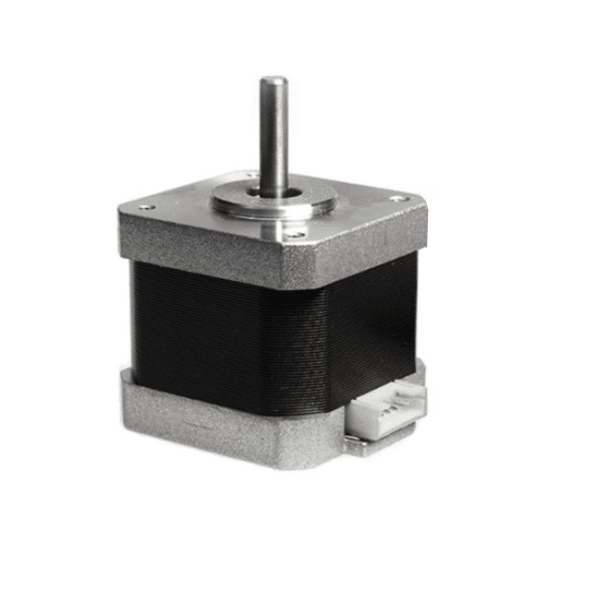
NEMA 17 Stepper Motor (Used / Fully Tested)

  • Standard NEMA 17 frame for broad compatibility
  • 1.8° step angle (200 steps/rev) for precise control
  • High torque (~40–50 N·cm, model dependent)
  • Bipolar 4-wire design for reliable performance
  • Tested & fully functional used unit – minor cosmetic wear
  • Ideal for 3D printers, CNC, robotics, and automation

Apple Shopping Event

Hurry and get discounts on all Apple devices up to 20%

100,00 EGP

16 People watching this product now!

Payment Methods:

Description

Power your next hardware build with our reliable, gently used NEMA 17 Stepper Motor. Pulled from working industrial or consumer equipment, these motors are rigorously tested for coil continuity, torque retention, and step accuracy to ensure they perform just like new. The NEMA 17 is the gold standard for precision control in the maker and electronics community. Whether you are repairing a 3D printer mainboard setup, building a custom CNC machine, or prototyping an autonomous maze-solving robot, this cost-effective motor delivers the exact positional accuracy you need without the premium price tag.


Key Features

  • Cost-Effective Prototyping: An ideal, budget-friendly solution for rapid hardware development and testing.

  • Universal Compatibility: Interfaces seamlessly with standard motor drivers such as the A4988, DRV8825, TMC2209, or L298N modules, making it perfect for Arduino or ESP32-based projects.

  • High Precision: Delivers a $1.8^circ$ step angle for smooth, accurate, and repeatable movements.

  • Standardized Form Factor: Features the industry-standard NEMA 17 faceplate ($42.3 text{ mm} times 42.3 text{ mm}$) for easy mounting in standard brackets and 3D-printed chassis.

  • Quality Assured: Each used unit is manually inspected for physical integrity and electrically tested to guarantee immediate plug-and-play functionality.


Technical Specifications

(Note: As these are used/salvaged motors, exact specifications may vary slightly by manufacturer batch, but generally adhere to the following standard NEMA 17 baseline)

Specification Detail
Motor Type Bipolar Stepper
Step Angle $1.8^circ$ (200 steps per revolution)
Rated Voltage Typically 3V – 12V DC (Driven by current)
Rated Current ~1.2A to 1.7A per phase
Holding Torque ~40 N·cm to 45 N·cm
Phase Resistance ~1.5 $Omega$ to 2.5 $Omega$
Wiring 4-Wire (Standard Dupont or JST-XH connector)
Shaft Diameter 5 mm (typically D-shaft for secure pulley mounting)
Condition Used / Refurbished
🔌
Pin Connections
1 Table
Pin Connections Table 1
BoardSensor PinConnection
NEMA 17 coilsto driver outputA+/A-/B+/B- into a step/dir driver's motor terminals
📟
NEMA 17 Stepper Motor (Used / Fully Tested)
7 Examples • C/C++ | Boards: Arduino Uno, Arduino Nano, Arduino Mega, ESP32, ESP8266, STM32, Raspberry Pi Pico
NEMA 17 Stepper Motor (Used / Fully Tested) - Arduino Uno
NEMA 17 Stepper Motor (Used / Fully Tested) - Arduino Nano
NEMA 17 Stepper Motor (Used / Fully Tested) - Arduino Mega
NEMA 17 Stepper Motor (Used / Fully Tested) - ESP32
NEMA 17 Stepper Motor (Used / Fully Tested) - ESP8266
NEMA 17 Stepper Motor (Used / Fully Tested) - STM32
NEMA 17 Stepper Motor (Used / Fully Tested) - Raspberry Pi Pico
📄 File: nema_17_stepper_motor_(used_/_fully_tested)_-_arduino_uno.inoArduino Uno
844 characters
1//ekostra.com
2//electronics store in egypt
3//+201008896258
4
5// external driver (e.g. A4988/DRV8825): STEP=3, DIR=4 on Arduino Uno. Motor power comes from the driver's own VMOT supply, not the microcontroller.
6#define STEP_PIN 3
7#define DIR_PIN 4
8
9void setup() {
10 Serial.begin(115200);
11 pinMode(STEP_PIN, OUTPUT);
12 pinMode(DIR_PIN, OUTPUT);
13}
14
15void loop() {
16 digitalWrite(DIR_PIN, HIGH);
17 for (int i = 0; i < 200; i++) { // 200 steps = 1 full revolution on a 1.8deg/step motor at full-step
18 digitalWrite(STEP_PIN, HIGH);
19 delayMicroseconds(800);
20 digitalWrite(STEP_PIN, LOW);
21 delayMicroseconds(800);
22 }
23 delay(500);
24
25 digitalWrite(DIR_PIN, LOW);
26 for (int i = 0; i < 200; i++) {
27 digitalWrite(STEP_PIN, HIGH);
28 delayMicroseconds(800);
29 digitalWrite(STEP_PIN, LOW);
30 delayMicroseconds(800);
31 }
32 delay(500);
33}
📄 File: nema_17_stepper_motor_(used_/_fully_tested)_-_arduino_nano.inoArduino Nano
845 characters
1//ekostra.com
2//electronics store in egypt
3//+201008896258
4
5// external driver (e.g. A4988/DRV8825): STEP=3, DIR=4 on Arduino Nano. Motor power comes from the driver's own VMOT supply, not the microcontroller.
6#define STEP_PIN 3
7#define DIR_PIN 4
8
9void setup() {
10 Serial.begin(115200);
11 pinMode(STEP_PIN, OUTPUT);
12 pinMode(DIR_PIN, OUTPUT);
13}
14
15void loop() {
16 digitalWrite(DIR_PIN, HIGH);
17 for (int i = 0; i < 200; i++) { // 200 steps = 1 full revolution on a 1.8deg/step motor at full-step
18 digitalWrite(STEP_PIN, HIGH);
19 delayMicroseconds(800);
20 digitalWrite(STEP_PIN, LOW);
21 delayMicroseconds(800);
22 }
23 delay(500);
24
25 digitalWrite(DIR_PIN, LOW);
26 for (int i = 0; i < 200; i++) {
27 digitalWrite(STEP_PIN, HIGH);
28 delayMicroseconds(800);
29 digitalWrite(STEP_PIN, LOW);
30 delayMicroseconds(800);
31 }
32 delay(500);
33}
📄 File: nema_17_stepper_motor_(used_/_fully_tested)_-_arduino_mega.inoArduino Mega
845 characters
1//ekostra.com
2//electronics store in egypt
3//+201008896258
4
5// external driver (e.g. A4988/DRV8825): STEP=3, DIR=4 on Arduino Mega. Motor power comes from the driver's own VMOT supply, not the microcontroller.
6#define STEP_PIN 3
7#define DIR_PIN 4
8
9void setup() {
10 Serial.begin(115200);
11 pinMode(STEP_PIN, OUTPUT);
12 pinMode(DIR_PIN, OUTPUT);
13}
14
15void loop() {
16 digitalWrite(DIR_PIN, HIGH);
17 for (int i = 0; i < 200; i++) { // 200 steps = 1 full revolution on a 1.8deg/step motor at full-step
18 digitalWrite(STEP_PIN, HIGH);
19 delayMicroseconds(800);
20 digitalWrite(STEP_PIN, LOW);
21 delayMicroseconds(800);
22 }
23 delay(500);
24
25 digitalWrite(DIR_PIN, LOW);
26 for (int i = 0; i < 200; i++) {
27 digitalWrite(STEP_PIN, HIGH);
28 delayMicroseconds(800);
29 digitalWrite(STEP_PIN, LOW);
30 delayMicroseconds(800);
31 }
32 delay(500);
33}
📄 File: nema_17_stepper_motor_(used_/_fully_tested)_-_esp32.inoESP32
842 characters
1//ekostra.com
2//electronics store in egypt
3//+201008896258
4
5// external driver (e.g. A4988/DRV8825): STEP=26, DIR=27 on ESP32. Motor power comes from the driver's own VMOT supply, not the microcontroller.
6#define STEP_PIN 26
7#define DIR_PIN 27
8
9void setup() {
10 Serial.begin(115200);
11 pinMode(STEP_PIN, OUTPUT);
12 pinMode(DIR_PIN, OUTPUT);
13}
14
15void loop() {
16 digitalWrite(DIR_PIN, HIGH);
17 for (int i = 0; i < 200; i++) { // 200 steps = 1 full revolution on a 1.8deg/step motor at full-step
18 digitalWrite(STEP_PIN, HIGH);
19 delayMicroseconds(800);
20 digitalWrite(STEP_PIN, LOW);
21 delayMicroseconds(800);
22 }
23 delay(500);
24
25 digitalWrite(DIR_PIN, LOW);
26 for (int i = 0; i < 200; i++) {
27 digitalWrite(STEP_PIN, HIGH);
28 delayMicroseconds(800);
29 digitalWrite(STEP_PIN, LOW);
30 delayMicroseconds(800);
31 }
32 delay(500);
33}
📄 File: nema_17_stepper_motor_(used_/_fully_tested)_-_esp8266.inoESP8266
844 characters
1//ekostra.com
2//electronics store in egypt
3//+201008896258
4
5// external driver (e.g. A4988/DRV8825): STEP=D5, DIR=D6 on ESP8266. Motor power comes from the driver's own VMOT supply, not the microcontroller.
6#define STEP_PIN D5
7#define DIR_PIN D6
8
9void setup() {
10 Serial.begin(115200);
11 pinMode(STEP_PIN, OUTPUT);
12 pinMode(DIR_PIN, OUTPUT);
13}
14
15void loop() {
16 digitalWrite(DIR_PIN, HIGH);
17 for (int i = 0; i < 200; i++) { // 200 steps = 1 full revolution on a 1.8deg/step motor at full-step
18 digitalWrite(STEP_PIN, HIGH);
19 delayMicroseconds(800);
20 digitalWrite(STEP_PIN, LOW);
21 delayMicroseconds(800);
22 }
23 delay(500);
24
25 digitalWrite(DIR_PIN, LOW);
26 for (int i = 0; i < 200; i++) {
27 digitalWrite(STEP_PIN, HIGH);
28 delayMicroseconds(800);
29 digitalWrite(STEP_PIN, LOW);
30 delayMicroseconds(800);
31 }
32 delay(500);
33}
📄 File: nema_17_stepper_motor_(used_/_fully_tested)_-_stm32.inoSTM32
846 characters
1//ekostra.com
2//electronics store in egypt
3//+201008896258
4
5// external driver (e.g. A4988/DRV8825): STEP=PB0, DIR=PB1 on STM32. Motor power comes from the driver's own VMOT supply, not the microcontroller.
6#define STEP_PIN PB0
7#define DIR_PIN PB1
8
9void setup() {
10 Serial.begin(115200);
11 pinMode(STEP_PIN, OUTPUT);
12 pinMode(DIR_PIN, OUTPUT);
13}
14
15void loop() {
16 digitalWrite(DIR_PIN, HIGH);
17 for (int i = 0; i < 200; i++) { // 200 steps = 1 full revolution on a 1.8deg/step motor at full-step
18 digitalWrite(STEP_PIN, HIGH);
19 delayMicroseconds(800);
20 digitalWrite(STEP_PIN, LOW);
21 delayMicroseconds(800);
22 }
23 delay(500);
24
25 digitalWrite(DIR_PIN, LOW);
26 for (int i = 0; i < 200; i++) {
27 digitalWrite(STEP_PIN, HIGH);
28 delayMicroseconds(800);
29 digitalWrite(STEP_PIN, LOW);
30 delayMicroseconds(800);
31 }
32 delay(500);
33}
📄 File: nema_17_stepper_motor_(used_/_fully_tested)_-_raspberry_pi_pico.inoRaspberry Pi Pico
854 characters
1//ekostra.com
2//electronics store in egypt
3//+201008896258
4
5// external driver (e.g. A4988/DRV8825): STEP=14, DIR=15 on Raspberry Pi Pico. Motor power comes from the driver's own VMOT supply, not the microcontroller.
6#define STEP_PIN 14
7#define DIR_PIN 15
8
9void setup() {
10 Serial.begin(115200);
11 pinMode(STEP_PIN, OUTPUT);
12 pinMode(DIR_PIN, OUTPUT);
13}
14
15void loop() {
16 digitalWrite(DIR_PIN, HIGH);
17 for (int i = 0; i < 200; i++) { // 200 steps = 1 full revolution on a 1.8deg/step motor at full-step
18 digitalWrite(STEP_PIN, HIGH);
19 delayMicroseconds(800);
20 digitalWrite(STEP_PIN, LOW);
21 delayMicroseconds(800);
22 }
23 delay(500);
24
25 digitalWrite(DIR_PIN, LOW);
26 for (int i = 0; i < 200; i++) {
27 digitalWrite(STEP_PIN, HIGH);
28 delayMicroseconds(800);
29 digitalWrite(STEP_PIN, LOW);
30 delayMicroseconds(800);
31 }
32 delay(500);
33}
Bare bipolar stepper motor - needs a step/direction driver wired between it and the microcontroller.

Specification

Specification

WeightWeight280 g
Dimensions4,2 × 4,2 × 4 cm
Motor TypeStepper Motor
Frame SizeNEMA 17 (42×42 mm)
Voltage2–12V DC (depends on model)
Current1–2A per phase (typical)
Step Angle1.8° per step
ShaftSingle shaft, 5mm diameter (typical)
MaterialMetal & plastic components
Usage3D printers, CNC machines, robotics, precise motion control

Customer Reviews