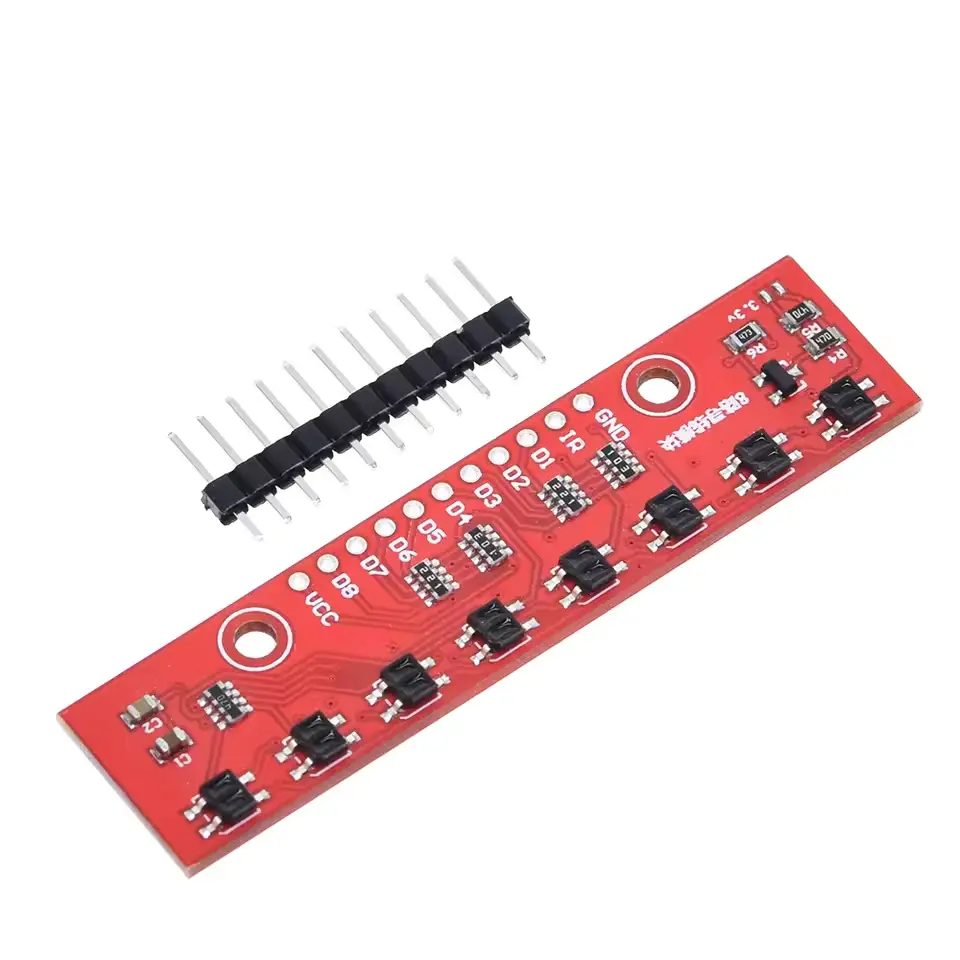
QTR-8RC Reflectance Line Follower Sensor Array

  • 🧭 QTR-8RC reflectance sensor array for line following
  • 🔦 8 IR LED/phototransistor sensors for accurate tracking
  • ⚡ RC output—easy reading with any microcontroller GPIO
  • 📏 Great for detecting lines, edges, and reflectance changes
  • 🎯 High sensitivity with adjustable calibration in code
  • 🤖 Ideal for line follower robots and maze solvers
  • 🛠️ Simple mounting holes—robot-friendly form factor
  • ✅ Works well with Arduino, ESP32, STM32, Raspberry Pi
SKU: AB1885 Categories: , Tags: ,

Apple Shopping Event

Hurry and get discounts on all Apple devices up to 20%

160,00 EGP

12 People watching this product now!

Payment Methods:

Description

The QTR-8RC is an 8-channel reflectance sensor array designed for line-following robots and surface detection applications. It uses infrared (IR) LEDs and phototransistors to detect the reflectivity of surfaces, making it ideal for robotics projects that require precise line tracking. The sensor array is easy to interface with microcontrollers and offers high-speed response for smooth and accurate movement. Its compact form factor allows seamless integration into small robotic platforms.

Features:

  • 8 independent reflectance sensors

  • Uses IR LEDs and phototransistors for surface detection

  • High-speed response for accurate line tracking

  • Easy to interface with microcontrollers (Arduino, ESP32, etc.)

  • Compact design suitable for small robotic platforms

  • Adjustable sensitivity using resistor networks

  • Compatible with reflective and non-reflective surfaces

Specifications:

  • Number of Sensors: 8

  • Sensor Type: Reflective IR (LED + Phototransistor)

  • Sensor Pitch: 0.315 inches (8 mm approx.)

  • Output Type: RC time measurement (capacitor charge time)

  • Supply Voltage: 3.3–5 V

  • Current Consumption: 8 mA per IR LED (typical)

  • Dimensions: 50 × 10 mm (approximate)

  • Connector: 5-pin header (VCC, GND, 8 outputs)

Applications:

  • Line-following robots

  • Surface detection and edge detection

  • Obstacle avoidance in mobile robots

  • DIY robotics and educational projects

  • Autonomous navigation for small vehicles

🔌
Pin Connections
1 Table
Pin Connections Table 1
BoardSensor PinConnection
QTR-8RCVCC/GND/LEDON/CH1-85V / GND / board digital pin / 8 board digital pins
📟
QTR-8RC Reflectance Line Follower Sensor Array
7 Examples • C/C++ | Boards: Arduino Uno, Arduino Nano, Arduino Mega, ESP32, ESP8266, STM32, Raspberry Pi Pico
QTR-8RC Reflectance Line Follower Sensor Array - Arduino Uno
QTR-8RC Reflectance Line Follower Sensor Array - Arduino Nano
QTR-8RC Reflectance Line Follower Sensor Array - Arduino Mega
QTR-8RC Reflectance Line Follower Sensor Array - ESP32
QTR-8RC Reflectance Line Follower Sensor Array - ESP8266
QTR-8RC Reflectance Line Follower Sensor Array - STM32
QTR-8RC Reflectance Line Follower Sensor Array - Raspberry Pi Pico
📄 File: qtr-8rc_reflectance_line_follower_sensor_array_-_arduino_uno.inoArduino Uno
544 characters
1//ekostra.com
2//electronics store in egypt
3//+201008896258
4
5// 8 channel pins on Arduino Uno: 2, 3, 4, 5, 6, 7, 8, 9
6#include <QTRSensors.h>
7
8QTRSensors qtr;
9const uint8_t SensorCount = 8;
10uint16_t sensorValues[SensorCount];
11
12void setup() {
13 Serial.begin(115200);
14 qtr.setTypeRC();
15 qtr.setSensorPins((const uint8_t[]){2, 3, 4, 5, 6, 7, 8, 9}, SensorCount);
16}
17
18void loop() {
19 qtr.read(sensorValues);
20 for (uint8_t i = 0; i < SensorCount; i++) {
21 Serial.print(sensorValues[i]); Serial.print('\t');
22 }
23 Serial.println();
24 delay(100);
25}
📄 File: qtr-8rc_reflectance_line_follower_sensor_array_-_arduino_nano.inoArduino Nano
545 characters
1//ekostra.com
2//electronics store in egypt
3//+201008896258
4
5// 8 channel pins on Arduino Nano: 2, 3, 4, 5, 6, 7, 8, 9
6#include <QTRSensors.h>
7
8QTRSensors qtr;
9const uint8_t SensorCount = 8;
10uint16_t sensorValues[SensorCount];
11
12void setup() {
13 Serial.begin(115200);
14 qtr.setTypeRC();
15 qtr.setSensorPins((const uint8_t[]){2, 3, 4, 5, 6, 7, 8, 9}, SensorCount);
16}
17
18void loop() {
19 qtr.read(sensorValues);
20 for (uint8_t i = 0; i < SensorCount; i++) {
21 Serial.print(sensorValues[i]); Serial.print('\t');
22 }
23 Serial.println();
24 delay(100);
25}
📄 File: qtr-8rc_reflectance_line_follower_sensor_array_-_arduino_mega.inoArduino Mega
561 characters
1//ekostra.com
2//electronics store in egypt
3//+201008896258
4
5// 8 channel pins on Arduino Mega: 22, 23, 24, 25, 26, 27, 28, 29
6#include <QTRSensors.h>
7
8QTRSensors qtr;
9const uint8_t SensorCount = 8;
10uint16_t sensorValues[SensorCount];
11
12void setup() {
13 Serial.begin(115200);
14 qtr.setTypeRC();
15 qtr.setSensorPins((const uint8_t[]){22, 23, 24, 25, 26, 27, 28, 29}, SensorCount);
16}
17
18void loop() {
19 qtr.read(sensorValues);
20 for (uint8_t i = 0; i < SensorCount; i++) {
21 Serial.print(sensorValues[i]); Serial.print('\t');
22 }
23 Serial.println();
24 delay(100);
25}
📄 File: qtr-8rc_reflectance_line_follower_sensor_array_-_esp32.inoESP32
554 characters
1//ekostra.com
2//electronics store in egypt
3//+201008896258
4
5// 8 channel pins on ESP32: 13, 14, 27, 26, 25, 33, 32, 35
6#include <QTRSensors.h>
7
8QTRSensors qtr;
9const uint8_t SensorCount = 8;
10uint16_t sensorValues[SensorCount];
11
12void setup() {
13 Serial.begin(115200);
14 qtr.setTypeRC();
15 qtr.setSensorPins((const uint8_t[]){13, 14, 27, 26, 25, 33, 32, 35}, SensorCount);
16}
17
18void loop() {
19 qtr.read(sensorValues);
20 for (uint8_t i = 0; i < SensorCount; i++) {
21 Serial.print(sensorValues[i]); Serial.print('\t');
22 }
23 Serial.println();
24 delay(100);
25}
📄 File: qtr-8rc_reflectance_line_follower_sensor_array_-_esp8266.inoESP8266
556 characters
1//ekostra.com
2//electronics store in egypt
3//+201008896258
4
5// 8 channel pins on ESP8266: D0, D1, D2, D3, D4, D5, D6, D7
6#include <QTRSensors.h>
7
8QTRSensors qtr;
9const uint8_t SensorCount = 8;
10uint16_t sensorValues[SensorCount];
11
12void setup() {
13 Serial.begin(115200);
14 qtr.setTypeRC();
15 qtr.setSensorPins((const uint8_t[]){D0, D1, D2, D3, D4, D5, D6, D7}, SensorCount);
16}
17
18void loop() {
19 qtr.read(sensorValues);
20 for (uint8_t i = 0; i < SensorCount; i++) {
21 Serial.print(sensorValues[i]); Serial.print('\t');
22 }
23 Serial.println();
24 delay(100);
25}
📄 File: qtr-8rc_reflectance_line_follower_sensor_array_-_stm32.inoSTM32
570 characters
1//ekostra.com
2//electronics store in egypt
3//+201008896258
4
5// 8 channel pins on STM32: PA0, PA1, PA2, PA3, PA4, PA5, PA6, PA7
6#include <QTRSensors.h>
7
8QTRSensors qtr;
9const uint8_t SensorCount = 8;
10uint16_t sensorValues[SensorCount];
11
12void setup() {
13 Serial.begin(115200);
14 qtr.setTypeRC();
15 qtr.setSensorPins((const uint8_t[]){PA0, PA1, PA2, PA3, PA4, PA5, PA6, PA7}, SensorCount);
16}
17
18void loop() {
19 qtr.read(sensorValues);
20 for (uint8_t i = 0; i < SensorCount; i++) {
21 Serial.print(sensorValues[i]); Serial.print('\t');
22 }
23 Serial.println();
24 delay(100);
25}
📄 File: qtr-8rc_reflectance_line_follower_sensor_array_-_raspberry_pi_pico.inoRaspberry Pi Pico
566 characters
1//ekostra.com
2//electronics store in egypt
3//+201008896258
4
5// 8 channel pins on Raspberry Pi Pico: 10, 11, 12, 13, 14, 15, 16, 17
6#include <QTRSensors.h>
7
8QTRSensors qtr;
9const uint8_t SensorCount = 8;
10uint16_t sensorValues[SensorCount];
11
12void setup() {
13 Serial.begin(115200);
14 qtr.setTypeRC();
15 qtr.setSensorPins((const uint8_t[]){10, 11, 12, 13, 14, 15, 16, 17}, SensorCount);
16}
17
18void loop() {
19 qtr.read(sensorValues);
20 for (uint8_t i = 0; i < SensorCount; i++) {
21 Serial.print(sensorValues[i]); Serial.print('\t');
22 }
23 Serial.println();
24 delay(100);
25}
8-channel RC-style reflectance array (timed discharge, not a simple digital read) - Pololu QTR library handles the timing.

Specification

Specification

WeightWeight6 g
Dimensions3 × 2 × 1 cm
NameQTR-8RC Reflectance Sensor Array
Number of Sensors8
Sensor TypeReflective IR (LED + Phototransistor)
Sensor Pitch8 mm
Output TypeRC time measurement
Supply Voltage3.3–5 V
Current Consumption8 mA per IR LED
Dimension50×10 mm
Connector5-pin header
ApplicationLine-following robots, surface detection, edge detection, DIY robotics

Customer Reviews