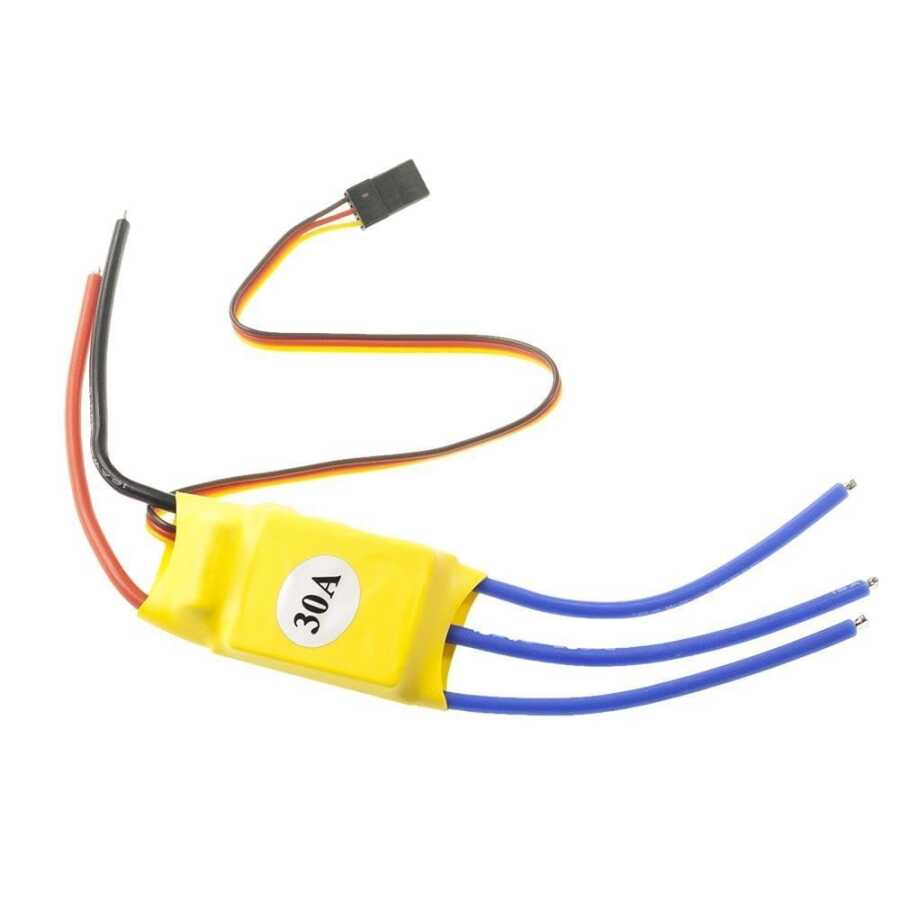
This module is a 30A Electronic Speed Controller (ESC) designed to control the speed, direction, and braking of brushless DC motors (BLDC) in drones, RC vehicles, boats, and robotics applications.
The 30A ESC with Bare Wires delivers smooth and responsive throttle control, supporting motors up to 30A current capacity. It features bare wire connections for flexible integration and customization in a wide range of power systems.
With support for both 2S–3S LiPo batteries and high-speed signal response, this ESC ensures efficient, reliable performance during demanding operations. It’s pre-programmed with standard firmware and is compatible with most remote control systems and flight controllers.
Features:
Rated for brushless motors up to 30A continuous current
Supports 2S–3S LiPo battery input (7.4V–11.1V)
Bare wires for flexible, customizable connections
Fast throttle response and smooth motor control
Ideal for RC drones, airplanes, boats, and robotics
Lightweight and compact design for tight builds
Package Includes:
1 x 30A ESC (Electronic Speed Controller) for Brushless Motor – Bare Wire Type
🔌
Pin Connections
1 Table
Pin Connections Table 1
Board
Sensor Pin
Connection
ESC
Signal/VCC/GND
board PWM-capable pin / (BEC 5V out - don't also power the board from it unless you know what you're doing) / GND
📟
ESC (Speed Controller for Brushless Motor) 30A with Bare Wires
ESC (Speed Controller for Brushless Motor) 30A with Bare Wires - Arduino Uno
ESC (Speed Controller for Brushless Motor) 30A with Bare Wires - Arduino Nano
ESC (Speed Controller for Brushless Motor) 30A with Bare Wires - Arduino Mega
ESC (Speed Controller for Brushless Motor) 30A with Bare Wires - ESP32
ESC (Speed Controller for Brushless Motor) 30A with Bare Wires - ESP8266
ESC (Speed Controller for Brushless Motor) 30A with Bare Wires - STM32
ESC (Speed Controller for Brushless Motor) 30A with Bare Wires - Raspberry Pi Pico
📄 File: esc_(speed_controller_for_brushless_motor)_30a_with_bare_wires_-_arduino_uno.inoArduino Uno
702 characters
1//ekostra.com
2//electronics store in egypt
3//+201008896258
4
5// ESC signal pin 9 on Arduino Uno. ESCs speak the same protocol as a hobby servo (1000-2000us pulses), so the Servo library works even though there's no rotation involved.
6#include <Servo.h>
7
8Servo esc;
9#define ESC_PIN 9
10
11voidsetup() {
12Serial.begin(115200);
13 esc.attach(ESC_PIN, 1000, 2000);
14 esc.writeMicroseconds(1000); // arm at minimum throttle - required by most ESCs before they'll accept commands
15delay(3000);
16}
17
18voidloop() {
19 esc.writeMicroseconds(1300); // low throttle - INCREASE GRADUALLY AND CAREFULLY with a real propeller attached
20delay(2000);
21 esc.writeMicroseconds(1000); // back to minimum
5// ESC signal pin 9 on Arduino Nano. ESCs speak the same protocol as a hobby servo (1000-2000us pulses), so the Servo library works even though there's no rotation involved.
6#include <Servo.h>
7
8Servo esc;
9#define ESC_PIN 9
10
11voidsetup() {
12Serial.begin(115200);
13 esc.attach(ESC_PIN, 1000, 2000);
14 esc.writeMicroseconds(1000); // arm at minimum throttle - required by most ESCs before they'll accept commands
15delay(3000);
16}
17
18voidloop() {
19 esc.writeMicroseconds(1300); // low throttle - INCREASE GRADUALLY AND CAREFULLY with a real propeller attached
20delay(2000);
21 esc.writeMicroseconds(1000); // back to minimum
22delay(2000);
23}
📄 File: esc_(speed_controller_for_brushless_motor)_30a_with_bare_wires_-_arduino_mega.inoArduino Mega
703 characters
1//ekostra.com
2//electronics store in egypt
3//+201008896258
4
5// ESC signal pin 9 on Arduino Mega. ESCs speak the same protocol as a hobby servo (1000-2000us pulses), so the Servo library works even though there's no rotation involved.
6#include <Servo.h>
7
8Servo esc;
9#define ESC_PIN 9
10
11voidsetup() {
12Serial.begin(115200);
13 esc.attach(ESC_PIN, 1000, 2000);
14 esc.writeMicroseconds(1000); // arm at minimum throttle - required by most ESCs before they'll accept commands
15delay(3000);
16}
17
18voidloop() {
19 esc.writeMicroseconds(1300); // low throttle - INCREASE GRADUALLY AND CAREFULLY with a real propeller attached
20delay(2000);
21 esc.writeMicroseconds(1000); // back to minimum
5// ESC signal pin 25 on ESP32. ESCs speak the same protocol as a hobby servo (1000-2000us pulses), so the Servo library works even though there's no rotation involved.
6#include <Servo.h>
7
8Servo esc;
9#define ESC_PIN 25
10
11voidsetup() {
12Serial.begin(115200);
13 esc.attach(ESC_PIN, 1000, 2000);
14 esc.writeMicroseconds(1000); // arm at minimum throttle - required by most ESCs before they'll accept commands
15delay(3000);
16}
17
18voidloop() {
19 esc.writeMicroseconds(1300); // low throttle - INCREASE GRADUALLY AND CAREFULLY with a real propeller attached
20delay(2000);
21 esc.writeMicroseconds(1000); // back to minimum
5// ESC signal pin D1 on ESP8266. ESCs speak the same protocol as a hobby servo (1000-2000us pulses), so the Servo library works even though there's no rotation involved.
6#include <Servo.h>
7
8Servo esc;
9#define ESC_PIN D1
10
11voidsetup() {
12Serial.begin(115200);
13 esc.attach(ESC_PIN, 1000, 2000);
14 esc.writeMicroseconds(1000); // arm at minimum throttle - required by most ESCs before they'll accept commands
15delay(3000);
16}
17
18voidloop() {
19 esc.writeMicroseconds(1300); // low throttle - INCREASE GRADUALLY AND CAREFULLY with a real propeller attached
20delay(2000);
21 esc.writeMicroseconds(1000); // back to minimum
5// ESC signal pin PA8 on STM32. ESCs speak the same protocol as a hobby servo (1000-2000us pulses), so the Servo library works even though there's no rotation involved.
6#include <Servo.h>
7
8Servo esc;
9#define ESC_PIN PA8
10
11voidsetup() {
12Serial.begin(115200);
13 esc.attach(ESC_PIN, 1000, 2000);
14 esc.writeMicroseconds(1000); // arm at minimum throttle - required by most ESCs before they'll accept commands
15delay(3000);
16}
17
18voidloop() {
19 esc.writeMicroseconds(1300); // low throttle - INCREASE GRADUALLY AND CAREFULLY with a real propeller attached
20delay(2000);
21 esc.writeMicroseconds(1000); // back to minimum
22delay(2000);
23}
📄 File: esc_(speed_controller_for_brushless_motor)_30a_with_bare_wires_-_raspberry_pi_pico.inoRaspberry Pi Pico
710 characters
1//ekostra.com
2//electronics store in egypt
3//+201008896258
4
5// ESC signal pin 15 on Raspberry Pi Pico. ESCs speak the same protocol as a hobby servo (1000-2000us pulses), so the Servo library works even though there's no rotation involved.
6#include <Servo.h>
7
8Servo esc;
9#define ESC_PIN 15
10
11voidsetup() {
12Serial.begin(115200);
13 esc.attach(ESC_PIN, 1000, 2000);
14 esc.writeMicroseconds(1000); // arm at minimum throttle - required by most ESCs before they'll accept commands
15delay(3000);
16}
17
18voidloop() {
19 esc.writeMicroseconds(1300); // low throttle - INCREASE GRADUALLY AND CAREFULLY with a real propeller attached
20delay(2000);
21 esc.writeMicroseconds(1000); // back to minimum
22delay(2000);
23}
Electronic speed controller for brushless motors - controlled via a standard hobby-servo PWM signal.
Specification
Specification
WeightWeight
40 g
Dimensions
45 × 24 × 9 cm
Type
Electronic Speed Controller (ESC)
Current Rating
30A
Motor Type
Brushless (BLDC)
Input Voltage
6–12V DC (2–3S Li-ion/LiPo battery)
Output
3-phase for brushless motors
Interface
Bare wires for motor, battery, and signal connection
Material
PCB with electronic components, heat-resistant casing
Usage
RC cars, drones, boats, and other brushless motor applications




 Specification