

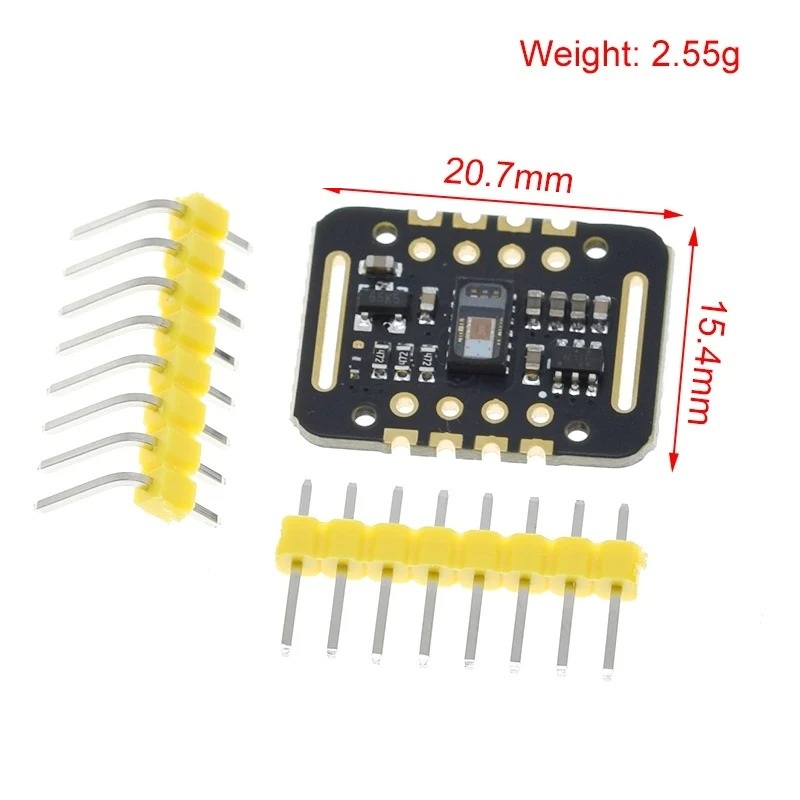
MAX30102 Pulse Oximeter Heart Rate Sensor Module
- 💓 MAX30102 pulse oximeter & heart-rate sensor module
- 🩸 Measures heart rate and SpO2 (blood oxygen level)
- 🔴🔵 Integrated red + IR LEDs with photodetector
- 🚌 I2C interface—easy to connect to Arduino/ESP32/STM32
- ⚡ Low power operation—great for wearable devices
- 🧩 Ideal for fitness tracking and health-monitoring prototypes
- 📈 Real-time readings suitable for DIY biomedical projects
- ✅ Popular choice for IoT health and sensing applications
175,00 EGP
In stock
In stock
Payment Methods:
Description
Product Description
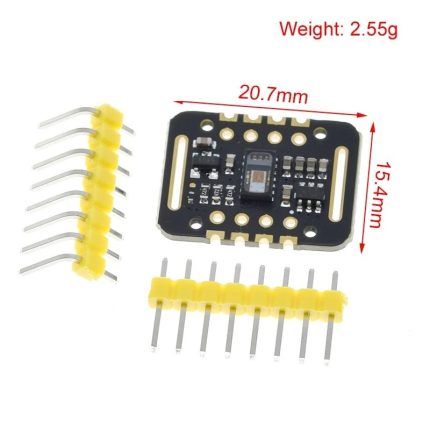
The MAX30102 Sensor Module is an integrated pulse oximeter and heart-rate sensor designed for wearable and health monitoring applications. It combines LEDs, photodetectors, and a high-sensitivity optical sensor in a compact module capable of measuring blood oxygen saturation (SpO₂) and heart rate (BPM) using light absorption.
This module is ideal for projects involving health tracking, fitness devices, biometric monitoring, and interactive wearables. It communicates over I²C and can be easily interfaced with Arduino, ESP32, STM32, Raspberry Pi, or any microcontroller with I²C support.
✨ Key Features
-
Measures heart rate (BPM) and blood oxygen saturation (SpO₂)
-
Built-in red and infrared LEDs with photodetector
-
Low power and compact design
-
Works over I²C interface (SDA, SCL)
-
Compatible with Arduino, ESP32, STM32, Raspberry Pi, etc.
-
Easy to integrate with open-source libraries
-
Ideal for health and fitness monitoring projects
-
Improved ambient light cancellation for accuracy
-
Can be mounted on finger or earlobe via custom housing
📐 Technical Specifications
📡 Sensor & Measurement
-
Sensor Type: Pulse oximeter and heart rate monitor
-
LEDs: Red (~660 nm) and Infrared (~880 nm)
-
Detection: Light absorption to estimate SpO₂ and pulse
-
Output: Digital via I²C
📶 Interface
-
Communication Protocol: I²C
-
Logic Level: 3.3 V (level shifting required for 5 V logic if needed)
-
Pins:
-
VIN/VCC: 3.3 V (some breakout boards support 5 V via regulator)
-
GND: Ground
-
SDA: I²C data
-
SCL: I²C clock
-
INT: Interrupt (optional)
-
🧠 Power
-
Operating Voltage: ~1.8 V core, 3.3 V supply (breakout boards may include regulator)
-
Low Power Consumption: Suitable for battery operation
🛠️ Compatibility
-
Microcontrollers: Arduino, ESP32, STM32, PIC, AVR, etc.
-
Single-board Computers: Raspberry Pi, BeagleBone, etc.
📦 Physical
-
Module Size: Small, compact breakout board
-
Mounting: Pin headers or solder points
🧰 Typical Applications
-
Heart rate monitoring
-
Blood oxygen saturation (SpO₂) measurement
-
Wearable health trackers
-
Fitness and wellness devices
-
Biometric sensing systems
-
Interactive health projects for makers
🔧 How It Works (Quick Overview)
-
Place the sensor where blood flow is detectable (finger, earlobe).
-
Illuminate with LEDs: Red and infrared light penetrate tissue.
-
Measure reflected light: Detector captures variations due to blood flow.
-
Compute SpO₂ and BPM: Firmware algorithms derive physiological values.
-
Output via I²C: Microcontroller reads sensor data for processing and display.
🧠 Integration Tips
-
Use established libraries (like Arduino MAX3010x libraries) to simplify coding.
-
Add proper time averaging and signal filtering for more stable readings.
-
Ensure good sensor contact (gentle pressure) for accurate detection.
-
Keep the sensor area free of ambient light interference.
Specification
General
| WeightWeight | 0,00 g |
|---|---|
| Product Type | Pulse Oximeter & Heart Rate Sensor Module |
| Sensor IC | MAX30102 |
| Function | SpO₂ (Blood Oxygen) + Heart Rate (PPG) |
| Light Source | Red LED (660 nm) + IR LED (880/940 nm, typical) |
| Photodetector | Integrated |
| Interface | I²C (Address 0x57 typical) |
| Logic Level | 1.8–3.3 V (module often supports 3.3–5 V via regulator/level shift) |
| Supply Voltage | 3.3 V (typical) |
| Operating Current | Low-power (depends on LED current & sampling rate) |
| Sampling Rate | Up to 3200 samples/sec (IC capability) |
| ADC Resolution | 18-bit (typical) |
| Operating Temperature | -40°C to +85°C (IC) |
| Module Pins (Typical) | VIN/VCC, GND, SDA, SCL, INT |
| Dimensions | ~20×15×3 mm (typical) |
| Applications | Wearables, fitness monitors, health projects, Arduino/ESP32 projects |